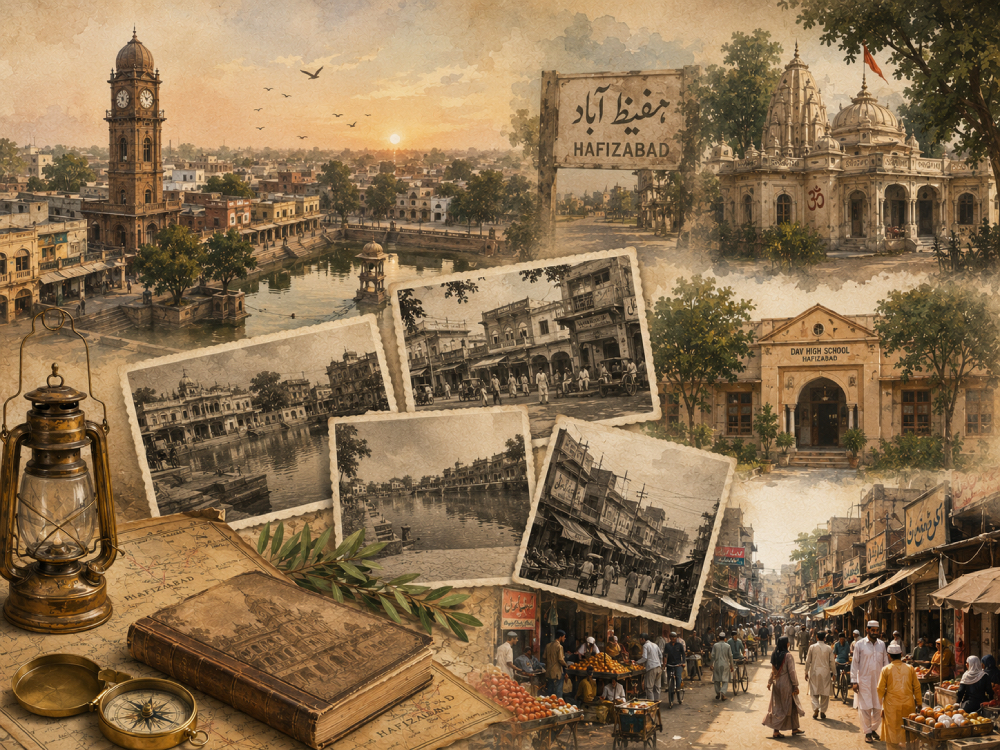


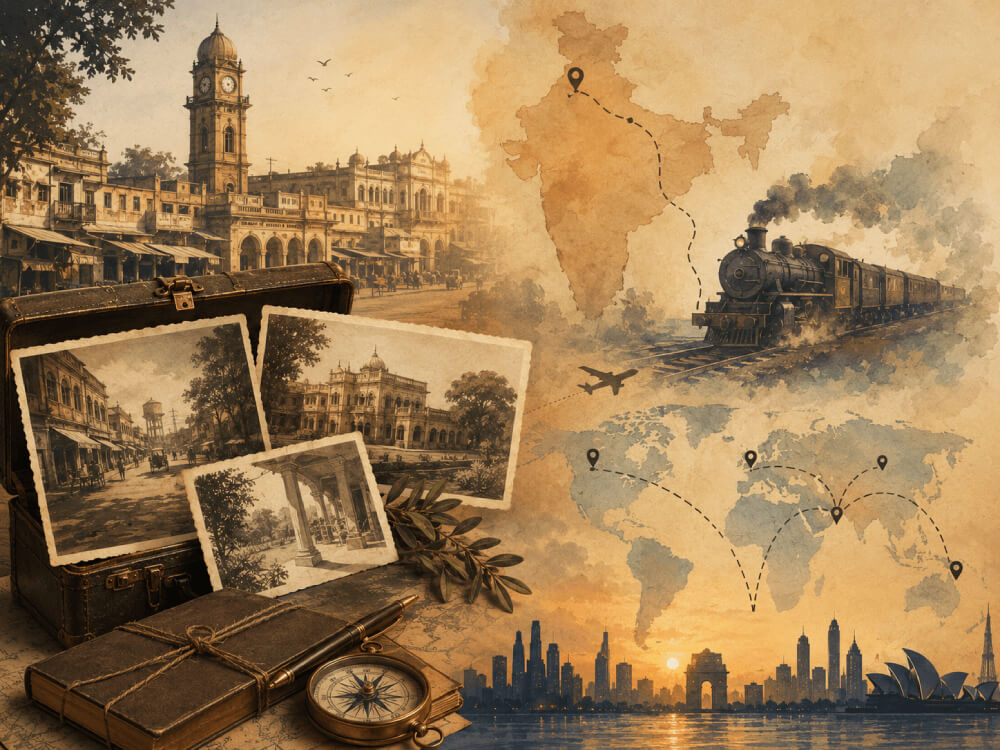
The Kapurs/Kapoors of Hafizabad were part of a vibrant and prosperous community before the Partition of India changed the course of history.
The Kapur family has the origin from the Khatri/Kshatriya community which has thousands of castes and as per hierarchy, Kapurs are considered the superior most Kshatriya caste. They are handsome, tall, strong, and brave, settled mainly in North India, and have excelled in various fields including Army and Film Industry. One story about them is that three Khatri named Mehar Chand, Khan Chand, and Kapur Chand went to Delhi and appeared before the Rajput wife of King Akbar who considered them as great warriors advised them to have marriages only between the 3 Punjabi Khatri families, ie. why they are called Dhai-Garh Khatris.
The Dhai Ghar Khatri (i.e. 2 ½ since the number 3 was considered unlucky) originally consisted of three clans (family groups) of North India including Kapur/Kapoor, Khanna, Mehra/Malhotra. Along with the Seth family, these form the Char Ghar grouping. With the Chopra, Dhavan, Mahendru, Sahgal, Talwar, Tandon, Vohra, and Wadhawan sub-castes, all 12 forms the barah-jati (12 Khatri castes) grouping within the Punjabi Khatris.
In the present book, we would be writing about Kapurs of Hafizabad where the elder of this family Lachi Ram Kapur s/o Hira Nand Kapur and grandson of Lakhami Das Kapur came to this town during the reign of Aurangzeb and was magistrate (Munsif) of the area. In the time of Maharaja Ranjeet Singh, the Kapur community achieved heights and remained on the top till the formation of Pakistan. The Kapurs were warrior, big Landlords, and titleholders – Dewans of the area. Their living was full of grandeur and they believed in Hinduism as well as Sikhism and were primarily not orthodox. However, they used to celebrate Samat, Basantpanchmi, Baisakhi, Dussehra, Deepawali, and Gurupurb, etc. with great enthusiasm.
The social ceremonies like marriage, the birth of a male child, first Lohri of the male child, first Lohri after the marriage of a male child, Mundan (first-time shave of the head), and Dastar Bandi (first-time turban-wearing by boys on reaching a certain age) used to be celebrated with grandeur.
The Kapurs were primarily agriculturist’s class and their custom and culture including the inheritance of the property were almost similar to those of the other Jats of the area. Every family used to keep at least one buffalo for milk, a horse for riding and some were also keeping tonga/baggi. Keeping firearms was considered prestigious.
The men’s wear mostly consisted of Pajama & Kurta, Salwar Kameez (Shirt), and cotton white chaddar wrapped around the chest or kept on the shoulder, some also used to wear a cotton coat during summer. The winter wear used to be Pajama & Kurta, Salwar & Kameez, a Lohi (a wool shawl woven locally), or a Sherwani/Achkan. The wearing of Pagri(turban or topi) was a must for all men of the family, a few used necktie also. When influential people visited British Officers, but didn’t understand or speak in English, they would wear an Apron mostly made of Malmal as an indication that the person would need an interpreter. The Birjes (long riding pants), full-length leather shoes, and jacket were worn while going on horse riding or hunting.
The women used mainly Salwar Kameez, Jhagha (a type of kurta) and Dupatta made of malmal and while going outside in public women wore a ‘Dhur’, which was a shawl type of covering over the dupatta and was made of either Latha or Boski cloth. During marriages or festivities, the Kurta/Kameez and Lassa which was embroidered with Bagh or Phulkari decoration and were very richly embroidered with gold and silver work. Wearing heavy gold ornaments was considered a fashion and prestige. The Jutti (footwear) worn on these occasions was also embroidered (the town of Kasur was famous for its embroidered Jutti’s).
The daughter of the community and even of the town was treated as a daughter of all. Attending the marriage of a girl was considered as must & pious and every possible help was given for the marriage considering the prestige of the town/community. The custom was to give requisite Shugan and not to accept any refreshment from the bride’s house on the occasion.
a. The Kapurs are considered descendants of Moon (Chander Vanshi).
b. Gotra of Kapur family is ‘Kaushal’
c. Bawa Bhan Shah is considered the Spiritual Guru of the Kapur family and his Samadhis in Thana Bhawan in Uttar Pradesh; there is also a temple at Panipat.
d. Hafizabadi Dharamsala at Haridwar near Ram Bhawan and opposite Rly. Station Haridwar got build by Pt. Hargopal with the property claim of Ramlila Gosain and with the collection of funds from people who had migrated from Hafizabad.
e. The Kapur Family Purohit
Haridwar:
Pandit Mula Ram Dhadhi Wale (Grandson of Pandit Jhandu Ram),
Mahant Bishamber Giri Ki Haveli (Shital Lodge)
Kusha Ghat, Haridwar.
Mobile. 9411756722, 9634095124
Pehwa:
Pandit Upender Sharma Pawan Kumar,
Pandit Vikram Chakrapani Shashwat Chakrapani,
Shop No. 30 & 7, Saraswati Tat, Pehowa,
M : 9896111792, 9253478551, 8950311015, 8860000234, 7015093033.
Gotra is a term applied to a clan, group of families, or a linage – exogamous and patrilineal – whose members trace their descent in a common ancestor, usually as age of ancient times. There are eight main Gotras (subdivided into 49) that are descendants (family or spiritual descendants) of the seven rishis said to be sons of Brahma & Agastya Rishi who is also privileged with starting a lineage. The Saptarishis are Kashyapa, Atri, Vasistha, Vishwamitra, Gautama, Bhardwaja, and Jamadagni. All Hindus consider themselves the descendants of the above seven main sages who are believed to be mind-born sons of Brahma (‘The Creator’), who is one of the Hindu Trinity. Hindu Trinity being Brahma, Vishnu, and Mahesh. (Mahesh, another name for Lord Siva).
The Vedic Hindu followers need to know their Gotra, which they have to recite when performing various religious ceremonies like weddings, or post-death ceremonies like Shradha, Paksha, and Uttar Kriya. The reason for this is that as part of religious services the individual or family remembers his or their forefathers and ancestors. It is Gotra or Parivar (i.e. family) which provides this lineage. This tradition is over 5000 years old and is well documented on various stones, carvings, and copper plates.
The back ground of Bawaji is not known however popular belief is that a saint with great spiritual powers came to Hafizabad in the year 1840, made a hut on the raised platform on the East of Mohalla Kapuran and was taken care by the kapur family. The saint used to be busy in prayers and would meet the people in the morning and evenings only for short time after his prayers, treat patients with sprinkling of holly water from his karmandal. There are a number of interesting stories of miracles recited by the elders of which one story is that one kapur family man took his son who was suffering with acute eyes problems and told about the ailment. Baba Ji took the child in his lap sprinkled holy water from his Karmandal and gave the child back to his father saying ‘Bhagwan acha kare gae’ God will do the good. After a few days the father brought the child to Baba Ji and said ‘Baba Ji hale thuri Kaser baki hae’ (Some deficiency is still there). Baba Ji got annoyed and replied “ Mitra thuri kaser tehe rehegi”. The father later took the child far best treatment at various places but not a little of improvement.
The second very popular story is that Dewan Mool Raj Chopra declared himself as independent ruler of Multan in the year 1845 i.e. after the death of Maharaja Ranjeet Singh and got two British officer killed who had come to get revenue on behalf of the East India Company. Dewan Mool Raj Chopra’s Forces were defeated and number of his soldiers arrested including his senior officers and generals. The arrested officers were taken to Phillur Fort where the cases against them were proceeded and the military court ordered court Marshal for them as punishment. The punished officers appealed before British Governor General where they stated that they are being punished for their loyalty to the Sikh regime of which they were employees and for whom even their children would have died fighting. Now when the Sikh rule is not in existence, we can be loyal to British as well. The Governor General was very pleased with the answer and they were set free.
Maharaja Gulab Singh had allied with British in the war against the Sikh empire and had formed the princely state of Jammu & Kashmir with purchase of land from the British and was colleague of our fore fathers S. Gurdit Singh Kapur, Dewan Ram Rakha Mul Kapur and Dewan Ram Rang accompanied them to Hafizabad. Bawa Bhan Shaw predicted the release and advised young one to get prepared to receive their elders & Maharaja Gulab Singh (J&K) but the same was not believed at all. Bawa Ji also told the colours of the horses each one would be riding on. The surprise was that in the evening the elders reached Hafizabad along with Maharaja on the horses of the colour each one was predicted by Baba Ji. The whole Kapur Clan was surprised, became followers of Baba Ji and a huge area was built of marble for Baba Ji called ‘Samadhan’. on the occasion of Shivratri very large function was arranged at the Ashram for about 2-3 days and a huge Bhandra at the close.
Maharaja Gulab Singh was impressed by the bravery, loyalty and intelligence of Kapurs hence he requested for some young intelligent & educated men from this family for his employment on crucial jobs and as a result Dewan Moti Ram Kapur, Dewan Ajodhya Prasad Kapur, Dewan Mharaj kishan Kapur, Dewan Ram Nath Kapur went to J&K with him who served Maharaja on highly responsible posts.
Bawa Bhan Shah was the founder of this Gadhi and at the time of partition his disciple Bawa Balaki was the occupant and Bawa Budhraj was his disciple. After the partition in the year 1947 Bawa Budha shifted to Panipat and later got Samadh Build at Thana Bhawan (U P) from the claim received for the left property and more donations.
1st Guru Bawa Bhan Shah
2nd Guru Bawa Balaki
3rd Guru Bawa Bodh Raj (Budha)
4th Guru Bawa Madan Lal
5th Guru Bawa Amit Lal
The Kapur community of Hafizabad was a noble, aristocrat, hardworking, bold, chivalrous, disciplined, and full of life. The folk songs played an important part and had great significance in their life. It depicted the deep expressions and emotions of the people, on various occasions. The songs, at Hafizabad, were the very lifeline of its culture and were sung in groups at every occasion, which was different for different occasions, for eg., Haria, Suhag, Lorian, Ghorian, Sithnian, Alhanian, Bangra, Gidda, etc. The life of Kapurs was studded with songs and music which accompanied people from cradle to the grave i.e. lori to wein (wein were songs sung at death).
When a baby was born, all women of the family and the neighborhood would get together and sing Haria. Ghorian were also sung at the birth of a son since according to Khatri families, a son is like a bridegroom from the time of birth itself. The child would grow amidst Lories (lullabies) and the theme of the lullabies used to be invariably a mother’s wishful dream about her son.
The wedding songs were the most interesting and popular ones. They were sung by women at night to the accompaniment of the Dholki. When girls come from the husbands’ to the parent’s house to attend the marriage of their brother, they used to sing Sohile, the subject matter of which was great praise for the brother and the parental home.
The custom was that a few days before marriage, women would get together daily at night at the bride and bride groom’s house and sing to the accompaniment of the dholki. The songs sung at the bridegroom’s house were called Ghorian and those at the bride’s house Suhag. The expectation of mother and sister from the marriage of a boy of the family were all expressed vividly in Ghorian.
Suhag was the echo of a young girl’s feeling, anxiety for the life ahead. It attracted the attention of the young girl’s hopes, dreams, and joys of life. Young girls of the Kapur family had no say in the choice of their husband and it was the parents who used to make the selection for them. The Girl’s feelings were sung in many of the Suhags. One folk-song, DEWIN VE BABLA OS GHARE (send me only to such a house, o, father), is an expression of a girl’s desire to go into a family where the mother-in-law is good and virtuous, the father-in-law holds an esteemed position, where mother-in-law has many buffaloes and such abundance of milk that the girl will be busy churning curd and making butter.
Mehandi meaning Henna was used for tinting of fingertips and palms of hands by young girls on festive occasions, particularly at weddings. The brides especially would get their palms, hands, and soles of their feet decorated with Henna. The SUHAG PURA which used to be a packet containing Henna etc. as a symbol of matrimonial happiness used to be sent ceremoniously from the bride-grooms house to that of the bride. On this occasion, Mehandi songs were sung.
When the marriage party arrives at the bride’s house, Sithnian were sung, which used to be full of wit, humour, and sarcasm. Sometimes women would find this as a handy medium to point out the weak points of the bridegroom’s party or any particular member of it. These songs used to be full of wit and sarcasm but were accepted in good humour.
Similarly, expressive songs were sung on many other occasions connected with marriage. When the bridegroom is led into the bride’s house before the wedding is solemnized, he had to recite Chhands. This was, in a way test of the boy’s ability to speak intelligently, his ready wit, and to know he is well acquainted with the ways of the world.
Songs were sung at the departure of the Doli which means the time of separation. The Doli songs used to be poignant, very touching and charged with emotions.
The mother-in-law also performed certain ceremonies and the songs were sung when the girl arrived at the house of her in-laws also. Besides, there were numerous popular songs which were sung at various occasions and many of which have been now sung by famous singers like Surinder Kaur, Shivani Kashyap, etc. like – Lathe Di Chadar, Utte Saleti rang maiea, Kothe Te Aa Ja Hakim Tara Chand, Tenu Devangirupaipanj.
Haria ni mae, haria ni mae
Haria te bhagi bhariya ve
Jis dihare mera haria jammia
So hi dihara bhagi bhariya ve
Jamda haria guddar lapetiya
Kuchhad ditta ehna daiyan ve
Nahata dhota haria patt lapetiya
Milea ambar rani ve
Lai lai amber mere chhote di mae
Nitt hi khushian manadi jawe.
Haria ni mae haria ni bhene
Haria aye bhagi bharya ve
हरिया नी माए हरिया नी माए
हरिया ते भागी भरिया वे
जिस दिहाड़े मेरा हरिया जम्मया
सो ही दिहाड़ा भागी भरिया वे
जम्मदा हरिया गुड्डर लपेटिया
कुच्छड़ दिता एना दाइयाँ वे
नहाता धोता हरिया पट लपेटिया
मिलया अम्बड़ रानी वे
लै लै अम्बड़ मेरे छोटे दी माए
नित ही खुशियाँ मनांदी जावे
हरिया नी माए हरिया ने भेने
हरिया ते भागी भरिया वे
Alhar balhar bawe da
Bawa kanak liawe ga
Bawi beh ke chhatte gi
Premo punnia katte gi
Hambla mar ke uth mere shera
Ma balhari rabb dian rakkhan
Ichi bichi koko khaey
Gheo di churi kaka khaey
लोरियाँ
अलड़ बलड़ बावे दा
बावा कनक लिआवे गा
बावी बह के छट्टे गी
प्रेमो पुन्नियाँ कटे गी
हम्बला मार के उठ मेरे शेरा
माँ बलिहारी रब दियां राखों
ईची बिची कोको खाये
घयो दी चूरी काका खाये
Ni dhiye chandan de ole kiyon khari?
Main te khari san babal ji de paas
Babal ver loriae
Ni keojia Var loriae?
Var mangaan mein te ram jayee
Sass mangaan mein te rani kaushalya jayee
Te saura mangaan raja dasarth jeya var loriye
Ni dhiya chandan de ole kiyon khari?
सुहाग
नी धीए चन्दन दे ओले ओले क्यों खड़ी?
मैं ते खड़ी सां बाबल जी दे पास
बाबल वर लोड़िए
नी कियो जया वर लोड़िए
वर मंगा मैं ते राम जया
सास मंगा मैं ते रानी कौशल्या जई
ते सौरा मंगा राजा दशरथ जिया वर लोड़िए
नी धीए चन्दन दे ओले ओले क्यों खड़ी?
Kaun kaun wade aya ve?
Mama te dharmi dharma karenda,
Chure da mamma daan karenda
Bhar lota ashnan karenda
Bhar chuli sankalp karenda
Ajj mere kolon eh kujh sarda
Lai lai lai ni rukman ranniey
Lai lai lai ni bhaiyan piariey
Chacha te dharmi dharma karenda
Gullian da chacha daan karenda
Bhar lota ashnan karenda
Bhar chuli sankalp karenda
Ajj mere kolon eh kujh sarda
Lai lai lai ni rukman ranniey
Lai lai lai ni bhaiyan piariey
veera te dharmi dharma karenda
motian da veera daan karenda
Bhar lota ashna karenda
Bhar chuli sankalp karenda
Ajj mere kolon eh kujh sarda
Lai lai lai rukman ranniey
Lai lai lai bhaiyan piariey
Babal te dharmi dharma karenda
Rupe da babal daan karenda
Sone da babal daan karenda
Kanya da babal daan karenda
Bhar lota ashna karenda
Bhar chuli sankalp karenda
Ajj mere kolon eh kujh sarda
Lai lai lai rukman ranniey
Lai lai lai bhaiyan piariey
Puchh di te gicchhdi
Mallan nagar wich aye
Wiah wala ghar kehra ve
Uchian uchian sabazz kanataan
Wiah wala ghar eho ve
Ae meri bhene Aa meri malan
Baith dalhize kar sehre da mul ve?
Ki kujh laini ai sehre da mul ve ?
Mein te laini Aa do lakh sehre da mul ve
Je tu chadhia ghori ve beeba
Je tu chadhia ghori ve
Tere naal bharawan jori ve
tu raj raja bania
Je tu katti jhandi ve beeba
Je tu katti jhandi ve
Teri maa ne shakkar vandi ve
Teri maa ne shakkar vandi ve
Tu raj raja bania
Beeba je tu chadhia khare ve
je tu chadhia khare
tere peo rupaiyye vare ve
Tu raj raja bania
Jawai wadde parware da
veer bahen samrai da
Khawand chore wali da.
Neeli ghori te kathi tile dar ni mae
Utte chadhe te lagge thanedar ni mae
Ghori teri mulla soni badi
Bandhi kathi de naal ne mae
Put ameeran da akhwao
Dhi sardaran di lai aao
Shehar nawaban de dhukna
पुछ्दी ते गिछ दी
मालन नगर विच आई
विआह वाला घर केड़ा वे
उचियां उचियां सब्ज कनातां
विआह वाला घर एहो वे
आ मेरी भैणे आ मेरी मालन
बैठ दलहीज कर सेहरे दा मुल वे?
की कुझ लैनी ऐ सेहरे दा मुल वे?
मैं ते लैनी आ दो लख सेहरे दा मुल वे
जे तू चढ़्या घोड़ी वे बीबा
जे तू चढ़्या घोड़ी वे
तेरे नाल भरावां जोड़ी वे
तू राज राजा बनिया
जे तू कट्टी झण्डी वे बीबा
जे तू कट्टी झण्डी वे
तेरे मां ने शक्कर वंडी वे
तेरे मां ने शक्कर वंडी वे
तू राज राजा बनिया
बीबा जे तू चढ़िया खारे वे
जे तू चढ़िया खारे
तेरे प्यो रुपये वारे वे
तू राज राजा बनिया
जवाई वड्डे परिवारे दा
वीर बहन समराई दा
खावन्द चोरे वाली दा
नीली घोड़ी ते काठी तिल्ले दार नी माए
उते चढ़े ते लग्गे थानेदार नी माए
घोड़ी तेरी मुल्ला सोनी बड़ी
बन्धी काठी दे नाल नी माए
पुत अमीरां दा अखवाओ
धी सरदारां दी लै आओ
शहर नवाबां दे ढुकना
Chunn chunn lai aao
Lahouri di patdi
Mein veere nu patdi
Baitha lainee aan
Chunn chunn lai aao
Lahouri de khare
Mein veere nu khare
Batha lainee aan
Chunn chunn lai aao
Lahouri da jora
Mein veere nu jora
Punah lainee aan
Oho jeewan joge de sagan
Mana lainee aan
Chunn chunn lai aao
Lahauri da sehra
Mein veere nu sehra
Saja lainee aan
Oho jiwan joge de sagan
Mana lainee aan
Chunn chunn lai aao
Lahauri di ghori
Mein veere nu ghori te
Baitha lainee aan
Oho jiwan joge de sagan
Mana lainee aan
चुन चुन के ले आओ
लाहौरी दी पटड़ी
मैं वीरे नू पटड़ी
बैठा लैनी आं
चुन चुन ले आओ
लाहौरी दे खारे
मैं वीरे नू खारे
बैठा लैनी आं
चुन चुन ले आओ
लाहौरी दे जोड़ा
मैं वीरे नू जोड़ा
पवा लैनी आं
ओहो जीवन जोगे दे सगन
मना लैनी आं
चुन चुन ले आओ
लाहौरी दा सेहरा
मैं वीरे नू सेहरा
सजा लैनी आं
ओहो जीवन जोगे दे सगन
मना लैनी आं
चुन चुन ले आओ
लाहौरी दी घोड़ी
मैं वीरे नू घोड़ी ते
बैठा आनी आं
ओहो जीवन जोगे दे सगन
मना लैनी आं।
WEIN-SIAPA AND ALHANIA were songs for mourning. These songs were poignant and helped release the pent-up emotions of the bereaved persons by expressing the pain of the departed soul.
Lala Lachi Ram Kapur, son of Hira Nand and grandson of Murli Dhar, great-grandson of Roop Chand, came to Hafizabad in the year 1740 as a Munsif (Administrator). He married into the Chopra caste (earlier inhabitants of the area) and permanently settled at Hafizabad.
Dewan Lachi Ram had eight sons. The family branches of Dewan Tara Chand and Dewan Sant Ram settled at Hafizabad, while other brothers settled at Kadarabad, Jamke, Jalalpur, Ram Nagar, Phagwara, Kapurthala, etc.
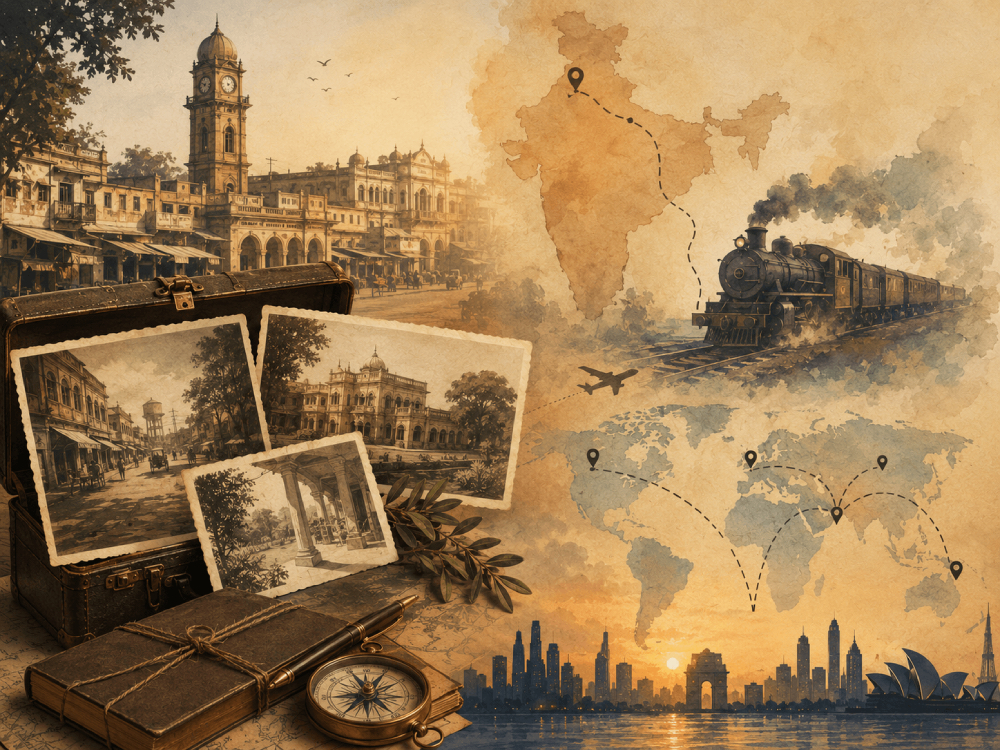
The Partition of India gave this family a major setback, but this bold, vibrant, and versatile family successfully established itself in various professions and trades across India and abroad.
S. Gurdit Singh Kapur was the first family member to serve under the Sikh regime. He joined the Cavalry under Prince Kharak Singh and married the daughter of Lala Nanak Chand, elder brother of Dewan Sawan Mul, Nazim of Multan.
Dewan Ram Rang, younger brother of S. Gurdit Singh, joined as a Kardar under Dewan Sawan Mul Chopra and later became Commandant at Dera Ghazi Khan and Dera Ismail Khan. He married the daughter of another brother of Dewan Sawan Mul, Lala Gurmukh Rai.
Ram Rakha Mul was also a Kardar under Dewan Sawan Mul.
Lala Hushnik Rai and Sadha Singh remained at Hafizabad and managed land and related matters.
Dewan Ram Dayal Kapur was a Nambardar, Zaildar, and courtier of the Governor’s Court. He was known as a sympathetic and helpful person toward the common people of the city and a God-fearing individual.
During times of calamity, he was often the first to come forward as a savior. He died at the age of 115 years in 1905 and was remembered as the Grand Old Man of Hafizabad.
General Harsukh Rai Kapur initially worked under Dewan Sawan Mul Chopra, Governor of Multan, in 1833.
Later, he was appointed Kardar (Administrator) of Haveli Pakpatan and Patti (near Lahore), and eventually became a General commanding a brigade.
He also served as a General in the British Army and was posted to Amritsar in 1857. He worked as an Extra Commissioner and was regarded as a tough and stubborn General.
He was the grandson of General Harsukh Rai and held the title of Rais-e-Azam Hafizabad, serving as an Honorary Magistrate.
He was known as a graceful, simple, and peace-loving person.
Dr. Maharaj Krishan Kapur completed his MBBS from King Edward Medical College, Lahore, and later earned DPHand DTM diplomas from London.
He served as:
He was deeply committed to the development of Hafizabad and initiated several projects, including:
For his contributions, he was awarded the title of Rai Bahadur by the British Government.
A historic town in present-day Pakistan, Hafizabad was once home to a thriving Kapurs/Kapoors community.
Learn about:
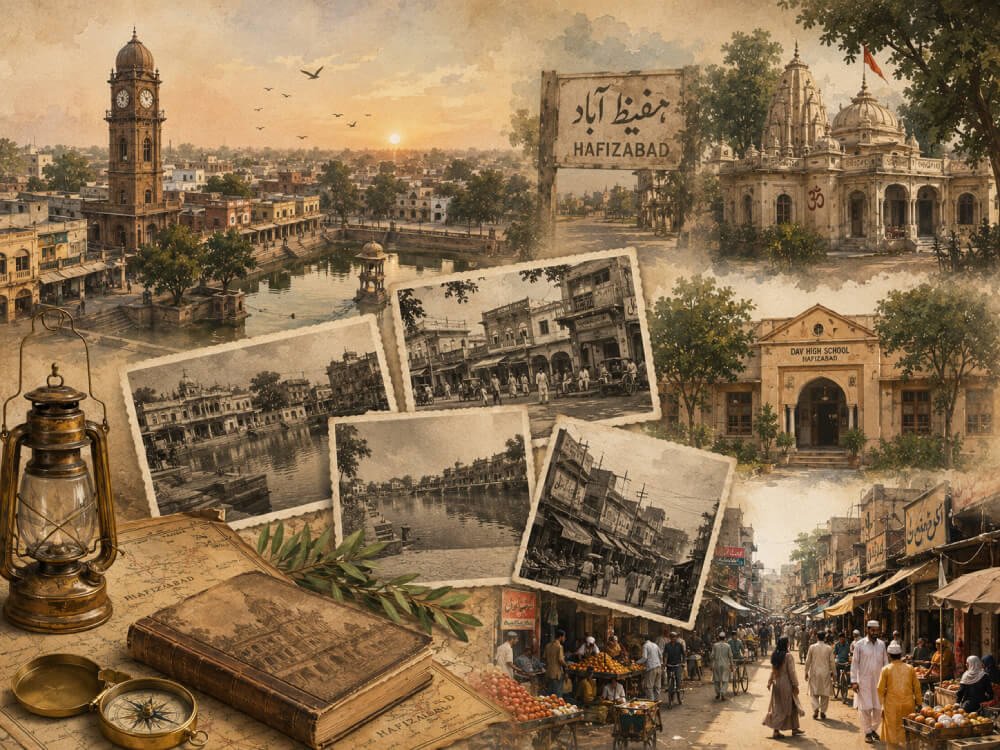
Hafizabad is a city and capital of the Hafizabad district located in Punjab, Pakistan. The city of Hafizabad is situated 30 miles west of Gujranwala and is 37 miles away from Wazirabad. The river Chenab forms its Northern and North-Western boundary, on the North-West it touches Mandi Bahauddin, in South, it has Sheikhupura, on the West it has Sargodha and Jhang, and Gujranwala is on the East. The geographical coordinates of Hafizabad are 32.4′ north 73.41’and has an Altitude of 207m. At the time of the partition in August 1947, it was the eighth railway station from Lyallpur (renamed to Faisalabad).
Hafizabad, at different times, has been ruled by many kings who had their capital in this area of Punjab. In the early seventh century, the Chinese traveler and Buddhist monk Hyun Tsang (alt. Chinese name Xuan Zhang) also came to this area and stayed at Jaipura (now known as Kot Hasan Khan), a village in Hafizabad Tehsil. In Ain-e-Akbari (Akbar’s biography) Hafizabad is mentioned as a Pargana in the Rachna Doab under the Lahore division. When Alexander the Great invaded India in 327 BC, the area of Sandal Bar on which Hafizabad is situated was well populated.
During the regime of Ashoka, the Great, Hafizabad was a big centre of Buddhism, and the big city of Asrora existed here, from here big statues & stupas have been found. The area was known to have been thickly populated along the River Chenab, both in the Hindu & Bodh periods.
There are several versions as to how the town was named Hafizabad, but a common belief is that Hafiz, a minister in King Akbar’s court and one of his favourites, got inhabit a township which took after his name as Hafiz Manarak, later getting renamed as Hafizabad.
During the Muslim period, the area of Punjab became a passage for Muslim Armies and Caravans going from Sindh to Sialkot, Kashmir, and Kabul who used to go through Hafizabad.
In the period of King Aurangzeb, the royal title holder Lachi Ram Kapur came to this place, he established relations with the Chopra caste and settled at Hafizabad. Over time as the influence of Samara & Arabs was eliminated in the Punjab region, and the power came into the hands of Hindus, the town developed as a Hindu town. The early Hindu inhabitants of Hafizabad were considered to be Chopras and Kapurs, who were rich and famous and owned about 2/3rd of the property in the town.
The Mughal Empire was already on its downfall during the regime of Aurangzeb, and after his death in AD 1707, ruinous wars of succession followed which made the empire both internally and externally weak. The Punjab region during most parts of the 18th century, between 1716 to 1799, was highly turbulent, as the rise of Sikhs and foreign invasion from Nader Shah of Iran created a lot of instability. The first large foreign attack on Hafizabad was of Nader Shah of Iran followed by endless attacks by other raiders. The foreign raiders used to loot the city and go back, after which the local raiders and thugs would come and take their bounty. It was also a saying among people of Hafizabad at that time ‘Khadda Peeta Lahe Da, Baki Bacha Nader Shahe Da’ (What so ever you eat that is yours, anything you save, that Nader Shah will take).
The ancient town of Hafiz Manark, which had been established by Hafiz during King Akbar’s reign got vanished due to numerous raids and attacks by foreign invaders. With the return of normal conditions, the people of the city started coming back and founded a new township with the same name, which is the present city Hafizabad. The people got together and made one market and to its north and south three streets leading to residential places named as Kucha Chopran, Kucha Sethian, Kucha Kasaban, Kucha Tandanan, Kucha Mahantan, Kucha Wadhawan, and constructed watch-towers and high walls around the town. The area was divided under the leadership of different Sardars (leaders) who constructed Qilas or forts for their protection for eg. Qila Didarsingh, Qila Mihan Singh, Qila Sahib Singh, etc. which were under the overall protection of Hakim Dayal Singh Merakotia. Hakim Dayal Singh had his residential house in Kucha Tanduwan and his Dewan-Khana (public court) was at a place called Chah Qaziwala. Under the protection of the foresaid headmen, the people from all religions got settled in Hafizabad and when others got confidence they also started coming back. Sardar Gurbaksh Singh Kapur in his book ‘Kapuran-e-Hafizabad’ describes that our ancestors ran to Kurali during the period of lawlessness and returned after the restoration of law & order and they named their street Gali Kapuran and the families of six brothers started living there, they made six houses and six shops and made the eastern gate of the city and thus the Kapur Kunba (Kunba, a clan or a family tree) was established at Hafizabad.
The research has revealed that the new city of Hafizabad starts from Kucha Sardar Jawahar Singh Kapur and the city came into existence in the year 1760. Sardar Gurbaksh Singh further writes that for making houses these people brought wood etc. from ruins of Sayyed Nagar near Alipur Chatha. The power of Sikhs affected common people to a great extent and the majority of Hindus adopted Sikhism.
The city was within a circular road. The Hindu population was in the middle and Muslims lived along the outer side of the road. The city had Tehsil, a Public Park in the East, and on the West well of Bawa Lal and Devi Dwara, and a hospital and towards south-west Idgah Akbari. On the South a graveyard, on the North along the road a well (Chah Kazi wala) with its lush green vegetables and flowers. The water of this well was used unto Mandi Tirath Ram Kapur. In addition to this well, there were four more wells which were used by the public for the bathing, etc. The old road to Gujranwala was through Qilla Didar Singh, the travel used to be on foot, horses, and bullock driven carts. The Tonga (horse-driven cart) stand was near the Eastern gate of the city and near Shivala Kapuran (Shiv temple) and later with the coming of the rail the horse carts were reduced. The horse carts used to take 10-12 hours to reach Gujranwala and were plying in groups due to the fear of dacoits.
The people hardly used to keep watches even in the offices there was no watch, the time was calculated with the help of the movement of stars, water dropping, and later with the help of sand dropping. The first Clock in Hafizabad was along the wall of the Tehsil office and the clock was a strange thing for the people over there particularly the movement of the Pendulum. The people were accustomed to calculate time through different unique methods- one interesting story is that the Tongas used to start at 5 am for long distances in groups and they used to get up one hour before far preparation, etc. One Tongawala—when asked by his colleagues to get up since the Tehsil clock has struck four would reply ‘Munu hale Muter Nahi Aya, Char kive waj Sakte Nai, Tehsil Da Ghanta Galat Hai’ (I am still not having the urge for urination then how it can strike four, the clock of Tehsil is wrong) and concerned Tongawala was proved to be correct.
Hafizabad was very famous for its functions, lifestyle, grandeur, Gurudwara Chavi Patshahi, Samadh Bawa Bhan Shah, various festivals, and especially Ram Lilla.
Hafizabad was known to be very jovial, lively, and a full of life community where Hindus & Muslims used to celebrate religious and social functions together with great enthusiasm. The religious harmony and respect for mutual beliefs and sentiments were to such extent that in Hafizabad neither Beef nor Pork was sold or consumed. In my recent visit to Pakistan, I was told that even today, the older residents of Hafizabad do not consume Beef – for which BBC Television had interviewed people to know about the reason.
During the Indian Rebellion of 1857, which is also called the Indian Mutiny, and throughout the Indian Independence movement, Muslims and Hindus fought together for India’s freedom struggle against the British rule. The Congress in August 1942 under the leadership of Mahatma Gandhi passed a resolution for the British to ‘Quit India’ which was followed by the resolution of the Muslim League in Karachi December 1943 ‘Divide and Quit India’ – this suddenly created wide differences and a big divide between the two communities, that could never be bridged again. Declaration of ‘Direct Action Day’ by Muhammad Ali Jinnah (one time a Congressman and now the leader of the Muslim League) resulted in widespread communal rioting and massacre between Muslims and Hindus in the city Calcutta in August 1946. This compelled British to leave India by August 1947, instead of earlier declared plans of August 1948. Winston Churchill (who was British Prime Minister until 1945), is known to have strongly condemned Great Britain’s ill-planned disengagement from India in 1947 and called it a ‘Shameful flight from India’.
After the declaration of independence, Hafizabad was quite peaceful until 12th August 1947; although underlying currents of insecurity and fear were prevalent and widespread. Both communities had organized massive vigilance, formed volunteer groups, and procured weapons and iron gates fixed up mainly in Hindu areas.
The trouble in Hafizabad started on the evening of 13th August when some Hindu owned shops were broke open, looted, and burnt. On 14th August the disaster started from Mandi Balaki Ram where almost all the shops were broke open, looted, and burnt. The rioting and looting now were in full swing in the city.
On 15th August; early morning four brothers- Mool Raj Kapur, Sardarilal Kapur, Satya Pal Kapur, and Vasdev Kapur went for a walk along the railway line and on their way back were attacked by a group of 20-25 persons. In the attack, two got killed and the other two were saved by Ch. Narain Das Kapur, who was highly respected by Muslims and was a very close friend of Malik Ali Bahadur (President of Muslim League, Hafizabad). Later about 9 AM, a big crowd gathered opposite Gurudwara Chavi Patshahi who wanted to hoist the Pakistan Flag on Gurudwara which was strongly resisted and there was a significant exchange of fire between the Police+Crowd and the Nihangs, who were residing in the Gurudwara. Assessing the situation the Police and the Muslim leaders advised the crowd to retreat without loss of life on any side.
The crowd now proceeded towards Mohallah Kapuran which had a solid defense and here also Muslim leaders played a wise and brotherhood role and advised the mob to go towards the main Bazaar and Tehsil Office instead of any residential locality. The crowd later had a huge peaceful procession in the main Bazaar.
On 16th August, due to fear of life, Hindu families gathered at Railway Station to leave Hafizabad for going to East Punjab. At this time several senior members of the Muslim community felt emotional and came to the Railway Station under the leadership of Malik Ali Bahadur and convinced their non-Muslim brethren not to leave Hafizabad, even though it was now in Pakistan, and brought the majority of them back. The town remained peaceful for some days, but this love and communal harmony could not last long since the same was not in the interest of mischief-mongers and rioters. These mischief-mongers and rioters have no religion, and on their eyes band age of lust and greed was tied and their hearts were full of hatred.
On 24th August, at about 8 o’clock at night, all of a sudden a crowd started looting shops in the city. The Mandir in Arianwala Bazaar was attacked and the Pujari was seriously injured, the crowd later tried to enter the residential streets which were resisted by Hindus by throwing stones and boiling water, etc. from their rooftops.
On 25th August, the looting and disaster continued in the town, a crowd attacked Ram Bhawan and wanted to put it on fire which was saved by Maer Fazil and Arian Braderi. On the same day, a military convoy came to Hafizabad, set up a camp in the Dera of Dewan Mulkh Raj Kapur & Dewan Milkhi Ram Kapur, and imposed a curfew from 7 pm to 4 am, thus bringing some peace to the town. The mayhem and murders continued in the surroundings of Hafizabad and for the affected families, Samadhi Bawa Bhan Shah and Harkaur Girls school were declared as camps.
The evacuation of Hindus from the Hafizabad area started on 8 September when the first military convoy of 30 trucks took around 800 to 900 Hindus & Sikhs for East Punjab.
There were many such treacherous, horrifying as well as good experiences however I have written experiences of which I have myself witnessed or have firsthand knowledge.
LINKAGES OF OLD HAFIZABAD WITH OTHER AREAS
Before the start of the Railways at Hafizabad the trade here was through waterways. The river Chenab was of utmost importance for Hafizabad and the goods used to be sent up to Sakher through boats. The boats used to start from Sudara and thereafter Rasul Nagar which was a big port. Pharuki Mohammedpur and Chuchuk were also river ports in Hafizabad area. The groups of boats used to start from Rasulpur and take goods unto Multan & Sakher after stoppages at different places in between. The Hafizabad used to send pure ghee and wood to Multan.
Road Travel
One road was from Gujranwala to Qilla Didar Singh, Nokhar, Hafizabad, and Jalalpur, the second road from Gujranwala to Pindi Bhattian via Wazirabad, Saroke, Rasulpur, Vanike, and Jalalpur, The third road were from Hafizabad to Wazirabad via Akalgarh (AlipurChatha) and Saroke. The fourth road was from Sheikhupura to Pindi Bhattian via Churkhana (Farukabad) Khanga Dogra and Sukheke. The fifth historical road was from Hafizabad to Lahore via Jabran, Qila Shekhupura, Shahdera, and the same road going up to Vanike and Kaderabad.
At Hafizabad, the old road to Gujranwala was through Qilla Didar Singh, the travel used to be on foot, horses, and bullock driven carts. The Tonga (horse-driven cart) stand was near the Eastern gate of the city and near Shivala Kapuran (Shiv temple) and later with the coming of the rail the horse carts were reduced. The horse carts used to take 10-12 hours to reach Gujranwala and were plying in groups due to the fear of dacoits. All the roads were not metalled.
The buses (coal operated) started operating only just before partition.
Railway Line
The first train connecting Hafizabad was started from Wazirabad to Lyallpur in August 1895 followed by a train from Wazirabad to Sangla Hills to Lyallpur in February 1896, later extended up to Toba Tek Singh in April 1899 and up to Khanewal in 1900.
Irrigation, Farming, and Trade
In the year 1885 a canal named upper Chenab was taken out from the river Chenab near Wazirabad and divided into two parts at Sagar and as the result of this canal network and the irrigation through river water the agricultural yield of the area was increased by manifold and people became prosperous.
The main crops of the area were wheat, rice, and cotton. The Hafizabad people being hard workers, bold and innovative started laying huge gardens with a variety of fruits, and Hafizabad was used to be called the city of Gardens. The Red Blood Malta of this place was famous in the whole of India.
Hafizabad was also famous for the weaving of Khes (a type of bed cover) and Lohi (warm shawl blanket).
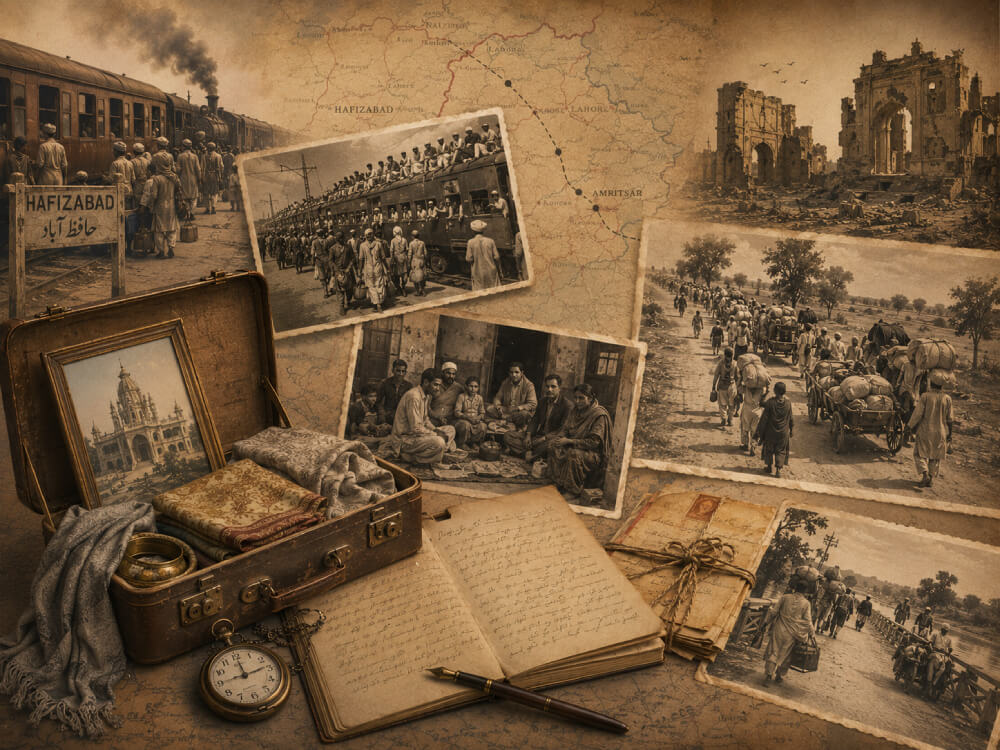
The year 1947 marked a turning point.
This section documents:
Preserving memories before they fade.
Help us preserve our shared heritage.