
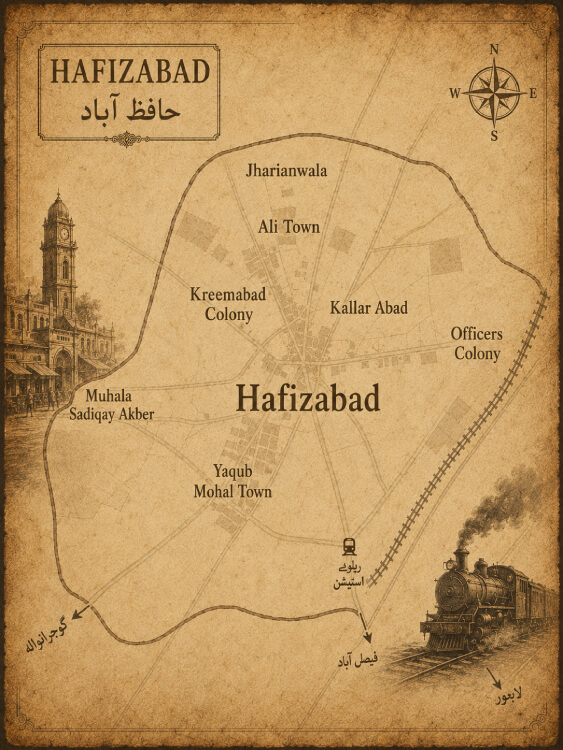
Hafizabad is situated 800 feet (240 m) above sea level and is 30 miles (46 Kilometre) west of Gujranwalan and is 75 miles (121 kms) from Lahore. The river Chenab forms its Northern and North- Western
boundary. It touches Mandi Bahudin in the North, It has
Sheikhupura on the South, on the West Sargodha and Jhang and on the East Gujranwala. The geographical coordinates of Hafizabad are Latitude 32, 0667 Longitude (73°.41?E) and has 207m Altitude; City
population in the year 1947 was 26, 000 and in the year 2012 —- 398922. It is 22 Km from Motor way N2.
Hafizabad is situated at a distance of 300 km from the Federal Capital, Islamabad. The district has a total area of 2,367 square kilometres and comprises two tehsils, namely Hafizabad and Pindi Bhatian Hafizabad is an old city. In 327 BC, when Sikandar-e-Azam attacked Hindustan, the territory of the Sandal Bar (where Hafizabad is now located) was a populated area. Big cities were located in this territory, and a lot of sub states were organized here in the time of Maharajaz and Rajaz.
Hafizabad is a city and capital of the Hafizabad district located in Punjab, Pakistan. The city of Hafizabad is situated 30 miles west of Gujranwala and is 37 miles away from Wazirabad. The river Chenab forms its Northern and North-Western boundary, on the North-West it touches Mandi Bahauddin, in South, it has Sheikhupura, on the West it has Sargodha and Jhang, and Gujranwala is on the East. The geographical coordinates of Hafizabad are 32.4′ north 73.41’and has an Altitude of 207m. At the time of the partition in August 1947, it was the eighth railway station from Lyallpur (renamed to Faisalabad).
Hafizabad, at different times, has been ruled by many kings who had their capital in this area of Punjab. In the early seventh century, the Chinese traveler and Buddhist monk Hyun Tsang (alt. Chinese name Xuan Zhang) also came to this area and stayed at Jaipura (now known as Kot Hasan Khan), a village in Hafizabad Tehsil. In Ain-e-Akbari (Akbar’s biography) Hafizabad is mentioned as a Pargana in the Rachna Doab under the Lahore division. When Alexander the Great invaded India in 327 BC, the area of Sandal Bar on which Hafizabad is situated was well populated.
During the regime of Ashoka, the Great, Hafizabad was a big centre of Buddhism, and the big city of Asrora existed here, from here big statues & stupas have been found. The area was known to have been thickly populated along the River Chenab, both in the Hindu & Bodh periods.
There are several versions as to how the town was named Hafizabad, but a common belief is that Hafiz, a minister in King Akbar’s court and one of his favourites, got inhabit a township which took after his name as Hafiz Manarak, later getting renamed as Hafizabad.
During the Muslim period, the area of Punjab became a passage for Muslim Armies and Caravans going from Sindh to Sialkot, Kashmir, and Kabul who used to go through Hafizabad.
In the period of King Aurangzeb, the royal title holder Lachi Ram Kapur came to this place, he established relations with the Chopra caste and settled at Hafizabad. Over time as the influence of Samara & Arabs was eliminated in the Punjab region, and the power came into the hands of Hindus, the town developed as a Hindu town. The early Hindu inhabitants of Hafizabad were considered to be Chopras and Kapurs, who were rich and famous and owned about 2/3rd of the property in the town.
The Mughal Empire was already on its downfall during the regime of Aurangzeb, and after his death in AD 1707, ruinous wars of succession followed which made the empire both internally and externally weak. The Punjab region during most parts of the 18th century, between 1716 to 1799, was highly turbulent, as the rise of Sikhs and foreign invasion from Nader Shah of Iran created a lot of instability. The first large foreign attack on Hafizabad was of Nader Shah of Iran followed by endless attacks by other raiders. The foreign raiders used to loot the city and go back, after which the local raiders and thugs would come and take their bounty. It was also a saying among people of Hafizabad at that time ‘Khadda Peeta Lahe Da, Baki Bacha Nader Shahe Da’ (What so ever you eat that is yours, anything you save, that Nader Shah will take).
The ancient town of Hafiz Manark, which had been established by Hafiz during King Akbar’s reign got vanished due to numerous raids and attacks by foreign invaders. With the return of normal conditions, the people of the city started coming back and founded a new township with the same name, which is the present city Hafizabad. The people got together and made one market and to its north and south three streets leading to residential places named as Kucha Chopran, Kucha Sethian, Kucha Kasaban, Kucha Tandanan, Kucha Mahantan, Kucha Wadhawan, and constructed watch-towers and high walls around the town. The area was divided under the leadership of different Sardars (leaders) who constructed Qilas or forts for their protection for eg. Qila Didarsingh, Qila Mihan Singh, Qila Sahib Singh, etc. which were under the overall protection of Hakim Dayal Singh Merakotia. Hakim Dayal Singh had his residential house in Kucha Tanduwan and his Dewan-Khana (public court) was at a place called Chah Qaziwala. Under the protection of the foresaid headmen, the people from all religions got settled in Hafizabad and when others got confidence they also started coming back. Sardar Gurbaksh Singh Kapur in his book ‘Kapuran-e-Hafizabad’ describes that our ancestors ran to Kurali during the period of lawlessness and returned after the restoration of law & order and they named their street Gali Kapuran and the families of six brothers started living there, they made six houses and six shops and made the eastern gate of the city and thus the Kapur Kunba (Kunba, a clan or a family tree) was established at Hafizabad.
The research has revealed that the new city of Hafizabad starts from Kucha Sardar Jawahar Singh Kapur and the city came into existence in the year 1760. Sardar Gurbaksh Singh further writes that for making houses these people brought wood etc. from ruins of Sayyed Nagar near Alipur Chatha. The power of Sikhs affected common people to a great extent and the majority of Hindus adopted Sikhism.
The city was within a circular road. The Hindu population was in the middle and Muslims lived along the outer side of the road. The city had Tehsil, a Public Park in the East, and on the West well of Bawa Lal and Devi Dwara, and a hospital and towards south-west Idgah Akbari. On the South a graveyard, on the North along the road a well (Chah Kazi wala) with its lush green vegetables and flowers. The water of this well was used unto Mandi Tirath Ram Kapur. In addition to this well, there were four more wells which were used by the public for the bathing, etc. The old road to Gujranwala was through Qilla Didar Singh, the travel used to be on foot, horses, and bullock driven carts. The Tonga (horse-driven cart) stand was near the Eastern gate of the city and near Shivala Kapuran (Shiv temple) and later with the coming of the rail the horse carts were reduced. The horse carts used to take 10-12 hours to reach Gujranwala and were plying in groups due to the fear of dacoits.
The people hardly used to keep watches even in the offices there was no watch, the time was calculated with the help of the movement of stars, water dropping, and later with the help of sand dropping. The first Clock in Hafizabad was along the wall of the Tehsil office and the clock was a strange thing for the people over there particularly the movement of the Pendulum. The people were accustomed to calculate time through different unique methods- one interesting story is that the Tongas used to start at 5 am for long distances in groups and they used to get up one hour before far preparation, etc. One Tongawala—when asked by his colleagues to get up since the Tehsil clock has struck four would reply ‘Munu hale Muter Nahi Aya, Char kive waj Sakte Nai, Tehsil Da Ghanta Galat Hai’ (I am still not having the urge for urination then how it can strike four, the clock of Tehsil is wrong) and concerned Tongawala was proved to be correct.
Hafizabad was very famous for its functions, lifestyle, grandeur, Gurudwara Chavi Patshahi, Samadh Bawa Bhan Shah, various festivals, and especially Ram Lilla.
Hafizabad was known to be very jovial, lively, and a full of life community where Hindus & Muslims used to celebrate religious and social functions together with great enthusiasm. The religious harmony and respect for mutual beliefs and sentiments were to such extent that in Hafizabad neither Beef nor Pork was sold or consumed. In my recent visit to Pakistan, I was told that even today, the older residents of Hafizabad do not consume Beef – for which BBC Television had interviewed people to know about the reason.
During the Indian Rebellion of 1857, which is also called the Indian Mutiny, and throughout the Indian Independence movement, Muslims and Hindus fought together for India’s freedom struggle against the British rule. The Congress in August 1942 under the leadership of Mahatma Gandhi passed a resolution for the British to ‘Quit India’ which was followed by the resolution of the Muslim League in Karachi December 1943 ‘Divide and Quit India’ – this suddenly created wide differences and a big divide between the two communities, that could never be bridged again. Declaration of ‘Direct Action Day’ by Muhammad Ali Jinnah (one time a Congressman and now the leader of the Muslim League) resulted in widespread communal rioting and massacre between Muslims and Hindus in the city Calcutta in August 1946. This compelled British to leave India by August 1947, instead of earlier declared plans of August 1948. Winston Churchill (who was British Prime Minister until 1945), is known to have strongly condemned Great Britain’s ill-planned disengagement from India in 1947 and called it a ‘Shameful flight from India’.
After the declaration of independence, Hafizabad was quite peaceful until 12th August 1947; although underlying currents of insecurity and fear were prevalent and widespread. Both communities had organized massive vigilance, formed volunteer groups, and procured weapons and iron gates fixed up mainly in Hindu areas.
The trouble in Hafizabad started on the evening of 13th August when some Hindu owned shops were broke open, looted, and burnt. On 14th August the disaster started from Mandi Balaki Ram where almost all the shops were broke open, looted, and burnt. The rioting and looting now were in full swing in the city.
On 15th August; early morning four brothers- Mool Raj Kapur, Sardarilal Kapur, Satya Pal Kapur, and Vasdev Kapur went for a walk along the railway line and on their way back were attacked by a group of 20-25 persons. In the attack, two got killed and the other two were saved by Ch. Narain Das Kapur, who was highly respected by Muslims and was a very close friend of Malik Ali Bahadur (President of Muslim League, Hafizabad). Later about 9 AM, a big crowd gathered opposite Gurudwara Chavi Patshahi who wanted to hoist the Pakistan Flag on Gurudwara which was strongly resisted and there was a significant exchange of fire between the Police+Crowd and the Nihangs, who were residing in the Gurudwara. Assessing the situation the Police and the Muslim leaders advised the crowd to retreat without loss of life on any side.
The crowd now proceeded towards Mohallah Kapuran which had a solid defense and here also Muslim leaders played a wise and brotherhood role and advised the mob to go towards the main Bazaar and Tehsil Office instead of any residential locality. The crowd later had a huge peaceful procession in the main Bazaar.
On 16th August, due to fear of life, Hindu families gathered at Railway Station to leave Hafizabad for going to East Punjab. At this time several senior members of the Muslim community felt emotional and came to the Railway Station under the leadership of Malik Ali Bahadur and convinced their non-Muslim brethren not to leave Hafizabad, even though it was now in Pakistan, and brought the majority of them back. The town remained peaceful for some days, but this love and communal harmony could not last long since the same was not in the interest of mischief-mongers and rioters. These mischief-mongers and rioters have no religion, and on their eyes band age of lust and greed was tied and their hearts were full of hatred.
On 24th August, at about 8 o’clock at night, all of a sudden a crowd started looting shops in the city. The Mandir in Arianwala Bazaar was attacked and the Pujari was seriously injured, the crowd later tried to enter the residential streets which were resisted by Hindus by throwing stones and boiling water, etc. from their rooftops.
On 25th August, the looting and disaster continued in the town, a crowd attacked Ram Bhawan and wanted to put it on fire which was saved by Maer Fazil and Arian Braderi. On the same day, a military convoy came to Hafizabad, set up a camp in the Dera of Dewan Mulkh Raj Kapur & Dewan Milkhi Ram Kapur, and imposed a curfew from 7 pm to 4 am, thus bringing some peace to the town. The mayhem and murders continued in the surroundings of Hafizabad and for the affected families, Samadhi Bawa Bhan Shah and Harkaur Girls school were declared as camps.
The evacuation of Hindus from the Hafizabad area started on 8 September when the first military convoy of 30 trucks took around 800 to 900 Hindus & Sikhs for East Punjab.
There were many such treacherous, horrifying as well as good experiences however I have written experiences of which I have myself witnessed or have firsthand knowledge.
LINKAGES OF OLD HAFIZABAD WITH OTHER AREAS
Before the start of the Railways at Hafizabad the trade here was through waterways. The river Chenab was of utmost importance for Hafizabad and the goods used to be sent up to Sakher through boats. The boats used to start from Sudara and thereafter Rasul Nagar which was a big port. Pharuki Mohammedpur and Chuchuk were also river ports in Hafizabad area. The groups of boats used to start from Rasulpur and take goods unto Multan & Sakher after stoppages at different places in between. The Hafizabad used to send pure ghee and wood to Multan.
Road Travel
One road was from Gujranwala to Qilla Didar Singh, Nokhar, Hafizabad, and Jalalpur, the second road from Gujranwala to Pindi Bhattian via Wazirabad, Saroke, Rasulpur, Vanike, and Jalalpur, The third road were from Hafizabad to Wazirabad via Akalgarh (AlipurChatha) and Saroke. The fourth road was from Sheikhupura to Pindi Bhattian via Churkhana (Farukabad) Khanga Dogra and Sukheke. The fifth historical road was from Hafizabad to Lahore via Jabran, Qila Shekhupura, Shahdera, and the same road going up to Vanike and Kaderabad.
At Hafizabad, the old road to Gujranwala was through Qilla Didar Singh, the travel used to be on foot, horses, and bullock driven carts. The Tonga (horse-driven cart) stand was near the Eastern gate of the city and near Shivala Kapuran (Shiv temple) and later with the coming of the rail the horse carts were reduced. The horse carts used to take 10-12 hours to reach Gujranwala and were plying in groups due to the fear of dacoits. All the roads were not metalled.
The buses (coal operated) started operating only just before partition.
Railway Line
The first train connecting Hafizabad was started from Wazirabad to Lyallpur in August 1895 followed by a train from Wazirabad to Sangla Hills to Lyallpur in February 1896, later extended up to Toba Tek Singh in April 1899 and up to Khanewal in 1900.
Irrigation, Farming, and Trade
In the year 1885 a canal named upper Chenab was taken out from the river Chenab near Wazirabad and divided into two parts at Sagar and as the result of this canal network and the irrigation through river water the agricultural yield of the area was increased by manifold and people became prosperous.
The main crops of the area were wheat, rice, and cotton. The Hafizabad people being hard workers, bold and innovative started laying huge gardens with a variety of fruits, and Hafizabad was used to be called the city of Gardens. The Red Blood Malta of this place was famous in the whole of India.
Hafizabad was also famous for the weaving of Khes (a type of bed cover) and Lohi (warm shawl blanket).

In the sixth century, when the famous Chinese tourist Hieun Tsaing came here, the area was backward but not empty. Then the tourist moved to
Sangla; he stayed one night in one good town then called Jai Pura, which was located near the village Koriala. But afterwards this territory became unpopulated and jungle like because of shortage ofwater and Afghan attackers. This situation persisted until King Akbar’s period. In Ashok’s period a big city was situated at the site of
the present village of Mehdi Abad; it was a holy place for Buddhists.
The following types of rice are cultivated in Hafizabad: Basmati 385, Basmati 386, Super Karnal, 1121 Sella, Ery Nine, Erey Six, Super Fan,
and KS 282. An other very famous place is Head Sagar Complex in which a Irrigation Canal is passing over a link canal. It is a very interesting place for visitors. [However the gardens are almost vanished.)
Help us preserve our shared heritage.