
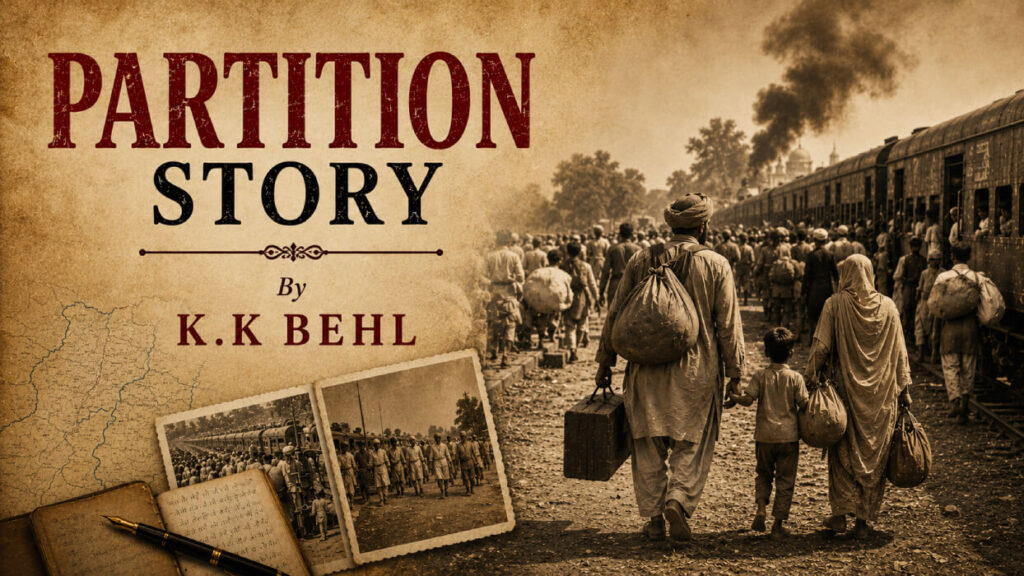
Father’s parental village was Jandraka, which was a big village on the Banks of Ravi river.It was 130 km southwest of Lahore,in Present day Pakistan. nearest town was Okara which was also the tehsil headquater. These days Okara is a full fledged district. Jandraka was about 30-35 km away from Okara.
My father belonged to a rich landlord family. They had lot of land and many people working for them. His family around the time of partition was staying in Okara for the purpose of education of children, because Okada being a urban centre had better education facilities.
When communal riots started, specially just before partition, most of it was in the urban areas like Rawalpindi, Lahore, Amritsar, Multan, and village areas were relatively spared of the riots. So our family thought that the situation is not good that time in the town, let us move to our parental village Jandraka, and we will come back when the situation improves. So they all shifted to Jandraka from Okara.But what actually happened was the opposite of this.
The wind of hatred and communalism started spreading so deeply and pervasively that it became a consensus that Hindus, whether in villages or in towns will not be allowed to stay in Pakistan. A frenzy or passion or madness took over the majority population. They would either kill the minority people or banish them or converted them to their religion. The same thing happened in the Indian Punjab that time called East Punjab. Here it became a consensus that no Muslim will be allowed to remain here. Although the minority population was sizeable (around 30% each side) but violence started to clean them off .So in such difficult time and in this scenario, no place remained safe. However, towns became relatively more safe because of some police and military presence. In the village, there was absolutely no protection and the village population became completely vulnerable to riots and communal violence. This was the opposite of what our family people had thought when they shifted to their parental village.
Now coming to the Hindu Sikh and Muslim harmony in our village. Hindus and Sikhs were considered the same and in many families of the village, half the members were Sikhs and half were Hindus. So this village Jandraka was a Hindu Sikh dominated village that was a large village, which now is a full fledge Mandi when I visited it in 2007, but this village was surrounded by more than 84 Muslim dominated villages. The Muslims of our village and nearby areas were very friendly and favourable to us Hindu Sikhs. Being big landlords, our ancestors had provided financial and other help to Muslim community. Our family had provided some land and money to build a mosque also. One of the poor muslim massion who had himself built the mosque was particularly friendly and indebted to us. His name was ‘Chiragdeen’. Soon this man was going be our saviour.
But friendliness of our village Muslims was not the case with Muslim villages which were slightly far away.
So as I had said earlier, the communal situation was so bad that it was consensus among Muslims that the Hindus will either be killed or converted to Islam. Muslims of 84 surrounding villages decided to attack us and eliminate us. We got this news through our village Muslims who were themselves very worried about this..
The attack actually happened also, but was averted due to an incident which our ancestors describe as a ‘miracle’. When the armed muslim mob came to attack us, a Babaji appeared on a white horse and wearing white clothes and said to them in Punjabi — “Twade pindaan te Sikh pae gayen han” meaning your villages have been attacked by Sikh people.So the Muslims who had come to attack us, retreated to their villages for defence.
But soon we came to know that they were planning another bigger attack on Thursday night ie Juma Raat in which they were not going to leave anyone in our village. It was almost a certainty that we would be killed soon if we don’t convert to Islam, but that was the last thing which our people would do, and they would accept death rather than giving up their religion. We will die fighting till the end and give as much resistance as possible.
The situation was extremely tense as it was only a few days that the attack would happen, and if anything had to be done, we had only three or four days for that. The village elders and wise people were actively thinking what to do but did not have much options.
Now coming to the national level again, things had become so bad that there was widespread killing all around, and even the military had become communal. The Muslim military in Pakistan, especially the Baloch regiment, was killing Hindus at various places. Every Hindu in so-called Pakistan region was unsafe and every Muslim in East Punjab ie Indian Punjab was equally unsafe .Seeing the situation getting out of control, Nehru and Liyakat Ali ,who are the respective leaders of their countries decided that population transfer was the only possible solution to whatever madness was happening. The leaders of the two nations, decided that Hindu military will go to Pakistan and who ever wants to come to India, they will bring those people here. The same would happen to East Punjab ie Indian Punjab, where Muslim military from Pakistan will come and take Muslims to Pakistan.
Military would come first to urban areas and towns and then go vulnerable villages to bring people to towns. The population of villages which were not so vulnerable would reach the towns by their own.
Now coming to our situation at Jandraka, our village elders came to know that Hindu military has either come to Okara( which was the nearest town), or is soon going to come there. The question was, will they come to our village to save us? Even bigger question was how would anybody reach Okara to ask for help? Whoever will try to go there will be killed by muslims in the way because that was largely a muslim dominated area.
Now what happened is the Central theme of the story and how our village muslims helped us to reach Okara safely. That itself is a big example of how even in such adversity, Hindus were helped by Muslims to escape to safety.
From our side, it was the only option that somebody goes to Okara and brings the Hindu military to the village. For this my father‘s paternal uncle (Chachaji), whose name was Lala Kundan Lal was appointed as the leader. He was highly educated and intelligent person, and was a graduate. Later when he came to India, he also became a teacher and principal of a college. He was considered the most practically wise person and was given the responsibility to go to Okara.
The Muslim community helped in this and appointed a person who would take him. I had earlier mention that a mission named ’Chiragdeen’ felt indebited to us because of the help we have given to the muslims earlier. So he took up the responsibly of saving us and took Lala Kundan Lal on his bicycle to Okara, which was 35 km from the village. On the way he was stopped many times by Muslim people who even tried to attack Lala Kundan Lal, but Chiragdeen fooled those Muslims by saying that he is taking this person, to convert to Islam—“ Mein isko Kalma pada kar musalmaan banane le ja raha hoon” that’s what he told everyone and also said that once this Hindu becomes a Muslim, his whole village will also convert. This is how by lying to all the people who stopped him in the way he somehow managed to take Lala Kundan Lal safely to Okara. This was an act of benovelence for which our people have always been grateful to him, and even when we came to India, there was a regular correspondence with him through letters and we always expressed our gratitude for all the help he provided us.
When Kundan Lal ji reached Okara, he got the information- that very day a unit of Hindu military has come. He found out where they had camped and reached them. It was a unit of Dogra regiment. He met their officer and told him about the situation in his village. The officer replied that their unit had just come. First they will collect and study the map of the area, understand the basic geography, talk to government officials about situation in different areas and villages. Only then they will decide when and where to go. Therefore he cannot send his troops at such a short notice in a totally new area which they had not studied.
Kundan Lal Ji argued that it was Tuesday on that day and on Thursday night,his village was going to be attacked, and it was a confirmed news. Even if you come after that, then of what use will it be for us, since we all will be dead by then. Kundan Lalji requested him again and again, but the officer did not agree. Kundan Lal ji was thinking how to convince these people of the enormous seriousness of the situation.
In the meantime, refreshment in the form of tea came for the soldiers. Kundan Lal Ji was naturally very upset that time. In his emotional outburst he said that Muslims by force will put cows meat in Hindus’ mouth and there will be no one to protect the Hindus. It is your duty to prevent all this, and if you don’t do that, then actually it is in your mouth that cow’s meat will go. All that you eat and drink, including the tea you are having right now, contains the flesh of our holy cow, if you fail to protect us.
Hearing this, one of the non-commissioned officers got agitated and in anger, he said to Kundan Lalji -“I will go with you”. Then he turned to his officer and said to him, “Sir, I am going with this person to his village. If you want, you can ask for my Courtmarshal later on, but I am not going to let people die in his village.” So he took a jeep and a machine gun in it along with maybe one or two soldiers and went with Kundan Lal Ji to our village Jandraka.
When they reached the village, lot of people on seeing the military vehicle thought that the communal military of Muslims ie the Baloch regiment has come, and now they will kill everyone. Many thought that their last time has come. It was a practice that time that before dying people used to kill their daughters and all young women of the family and if possible dump the dead bodies of women in some well or pit. This was done to prevent any sexual crime against their women, and did not let the enemy touch them.
In our village many people were planning to do this to their girls when Kundan Lalji came down from the jeep and told everyone that it was not the enemy, but our own military, which has come to take us to safety. Everyone took a sigh of relief then. Everyone was told to get ready in one or two hours and they should leave the village as soon as possible. Everyone started preparing and collected whatever belongings they could take with them, especially the money and gold.
Lot of people were not convinced that they were going forever. They thought after sometime, they would come back to their village. One of the logic which they used to think is that in history whenever power has changed, it is only the ruler and the administration which changes. The common population never gets changed. In their language, it was commonly said “Raja Badalta Hai, Praja Nahi Badalti.” But little did they know that this was actually going to happen.
Many people hid their valuables and gold somewhere, in the hope that when they come back, they will recover them. Many even gave the custody of such things to their Muslim friends. I don’t know whether anyone from our family did that, but when in 2007, I went to Jandraka, I came to know that many other families had done so and there belonging and wealth was utilised later by friendly Muslims.
Anyway, in a few hours, the whole village and the area got ready to go. With one machine gun vehicle and maybe two or three soldiers with some weapons, thousands of people followed them on foot. I am told by my father that some villages which came in the way had converted to Islam earlier, thinking that otherwise they will be killed. Now, when they saw the Hindus going with protection of the military, they also joined us to go to India. I think they started sometime in the evening and reached Okara by maybe in the morning or in the afternoon next day.
So when they reached Okara, it was divided into two parts, one the Hindu Okara, and the other the Muslim Okara. This was done to prevent any unnecessary rioting among Hindus and Muslims, and also due to logistic reason of shifting the whole population of Hindu Okara through ‘Kafilas’.
Kafila means a group of people often thousands of people walking together under the protection of the military. Once all the Hindus from the tehsil or district got collected in the town, they were taken together as a group to India. Mostly they were on foot and also carrying some of their belongings with them. For old people, pregnant ladies, children or disabled, the military used to take them in trucks and other vehicles. Such Kafilas would carry 30,000 or 40000 people and in some large districts like Lahore, Rawalpindi or Faisalabad, even population of lakhs was accommodated in these Kafilas.
The other option by which people were going to India was by train. People had started going on train quite early, but unfortunately, whatever trains went without security in the early phase could not reach the border because they were massacred on the way. The train was stopped on some pretext, and then the rioters from nearby areas would come with weapons and kill everybody, including children, women, and the elderly along with the young people. On our railway line that was from Multan to Lahore, a lot of trains had been butchered. But now Hindu military had reached and the trains had started moving with their security. Military vehicle with machine gun and some soldiers used to go with each train, and this is how the trains had started reaching the Indian border now.
Now coming to our family story, there were children, like my father was in eighth class and his younger brother was even four years younger to him. Other members of family were elder brother and elder sister of father along with father and mother. So for them, military people said that some of their vehicles would be coming after sometime, and if they want, the lady and children can stay back and come in those vehicles. Maybe there were children of some more families and their ladies who stayed back with our family. Grandfather, however, had to go with the Kafila on foot. Rest of the family stayed back waiting for the military vehicles to come.
But the dangerous thing which happened was that those vehicles never arrived. The whole Hindu Okara got emptied after people went in the Kafila. Only few children and the ladies of the families who had stayed back remained in the town. This was particularly dangerous because of the communal situation and the hatred between the communities. They were most likely going to be killed by the Muslim rioters if they soon did not leave that place. But how to do that, that was the question?
Soon they heard the whistle of an arriving train reaching the nearby railway station. They all quickly moved to the railway station to get into the train. Fortunately, that train was running with the security of Indian military. They were from the Gurkha regiment. The train was running on Multan to Lahore line .Coming from Multan it was scheduled to leave the way to Lahore and turn towards Ferozpur in India. This turn would be from a place called ‘Raiwind’ which was near Lahore, from where it would reach Ferozpur via a town called ‘Kasoor’.
On the railway station, some people were giving water to others and saying ‘Hindu Paani, Hindu Paani, Hindu Paani’ meaning ‘Hindu water’. It was so unfortunate that even the water was communalised. My father was very naughty, and he went off the train and started giving water to others by saying “Hindu Paani, Hindu Paani”. In the meantime, the engine whistled indicating that it the train was soon going to leave. Father’s brother was frantically looking for him and found him giving water to others. He scolded him and probably slapped him also and by holding his hand, pulled him into the train. This is how they all left Okara and the train started its journey towards India.
All trains were overloaded. The inside was packed with people and also the roof of the train had loads of people sitting on it. Our elders tell that before that train 12 trains had been massacred on way to India. Most of the trains were being cut between Raiwind and Kasoor, the two towns just preceding Ferozpur.
So this train, which our family boarded was running with the security of Gurkha regiment, as I had already described, they had vehicles and machine guns and soldiers accompanying the train.
Now the train driver of this train was a Muslim. He used to do mischief in the sense that he used to stop the train at a place where the rioting mob would come and attack the train, killing everybody. He must have done that earlier and now he tried to do the same thing with our train, but was not able to do it because of the military security.
But still at a railway station near Kasoor, he tried this tactic, hoping that the Gurkhas might go here and there if he tried to confuse them. Even if the Gurkhas moved away from the train for a brief period the mob can come and massacre the train. The confusion he created was that they don’t have permission to go ahead. He said that this is the last station for the train. No train will cross this station. This is the train of Pakistan and a train from India will come and take everybody there. This train will take the Muslims who are coming from India in the Indian train. The station master of that station was hand in glove with the driver who used to give red signal so that trains can be stoped. Together they were doing this drama. Actually this was totally a lie, and they did this in the hope that the military security might move away to ask the truth from somewhere else, maybe across the border or from some other station and they may get the opportunity to kill everyone in the train.
But our people ie Hindus in the train knew that the driver and station master were fooling them. They did not let the Gurkhas go anywhere. One of the persons in the train was engine driver himself. He said to the muslim driver that if you are not taking the train, then give me the permission to take the train to India, but those people were not agreeing to it. So the arguments and verbal fight continued for many hours, but the driver and the station master would not relent.
Just then, on the side track, a train full of Muslims came from Indian side and was going towards Kasoor. This train did not stop and crossed the station in full speed. Seeing this, our people got furious. The lie of the driver and station master was exposed, and the Gurkhas also got angry. One of them put his gun on the station master‘s head and said if you don’t give the signal, then he will kill him. The driver of the train was pushed down from the train and the Hindu driver who was in the train, started the train. This is how their life was saved and they reached Ferozpur on 5th September 1947. On reaching there, it was a wave of jubilation and happiness. Everyone got reassured that eventually their life is saved.
They stayed near the Ferozpur station for a few days and our grandfather who had come in the Kafila separately found the family there. Now at Ferozpur two very dangerous things happen to them. First was that due to scarcity of drinking water, some of the people, including the family of my grandfather’s brothers drank water from a nearby well. After drinking the water, they immediately had severe gastroenteritis, which was life threatening. Later they came to know that that the well contained the dead bodies of people who had been killed and thrown into the well .Most likely they would have been muslims who were massacred. Anyway, this was a serious thing, but fortunately, everyone got recovered from the Gastroenteritis.
The second calamity which they had to face was that of flooding of Sutlej river. Water started accumulating in the town and also in the railway station and its level was progressively increasing. Since the railway track is higher than other places, our family people got into one of the trains which was stationed, but soon the water which was rising came inside the train too. So they got to the topmost berth of the train, but it seemed that water level, which was rising, would come there also. So they thought that now they are going to die and grandfather started praying intensely.
But soon a miracle of sorts occurred and one of the walls lining the compound of the railway station suddenly broke by the weight of water, and a lot of water flowed outside the station, which decreased the water level in the train and at other places in the station. This is how their life was saved that time.
Fearing that water may return, they went to a high bridge near the railway station. There they stayed for a few days. Food was scarce and I think they manage to light a fire and had to eat boiled vegetation, which had collected nearby. How they survived those days on the bridge I don’t exactly remember, but they were able to tide over the time period of the flood and eventually were saved.
Now they didn’t exactly know where to go. They were roaming about here and there. They went to Ludhiana, where some houses of Muslims had got emptied. They lived in those houses for 2-3 months but had to vacate. My grandfather went to a place someplace in Madhya Pradesh for sometime, but eventually could not settle there also.
After sometime, the land rehabilitation process started. The land vacated by Muslims from Indian part of Punjab would be allotted to the people who had come from Pakistan and had owned land there. Actual permanent land allotment would take a lot of time after proper records would have exchanged among Indian and Pakistani establishment(eventually it turned out to be many years after partition).But for the interim period, within few months of partition, the government did temporary allotment of small pieces of land, so that they can earn a living out of it by agriculture or related activities.
My father’s family took that land near the land allotted to his maternal uncle (Mamaji) because Mamaji was emotionally very attached to father’s mother, ie his sister and was ready to help in any way he could.
But the problem was that my grandfather had always done educated sedentary work or run a shop of Ayurvedic Pharmacy. Being a big landlord, he had not directly done agriculture himself with his own hands.. Even father’s elder brother had not done that work and had lived mainly in urban areas. So he went to Delhi, to settle there. Younger brother of father was of tender age, may be of 10 years, and therefore he was also not ready for doing agriculture or any other earning activity. So, Mamaji of my father said that since someone has to work, my father will not go to school, but will have to get involved in activities for earning money .Father did agricultural activities and also worked in a shop selling consumer items. One thing he told about that was that he used to sell bangles also, and didn’t like putting bangles on ladies’ wrists.
Since all other children including the children from his Mamaji’s family were going to school, and he was the only one left, he got very disturbed. So once, when his elder brother visited them and was going back to Delhi, he climbed on the bus roof without telling anybody. In the way when the bus stopped, then my Tayaji came to know that father was also on the bus and was going to Delhi. Once in Delhi they tried to take the help of their Massi. Mausaji was a wealthy businessman in rural Lahore, his village name was Kot Radha Kishan. When he and his family came to India, they settled in Kingsway camp in Delhi.But even they were not able to get father settle down in any good employment or education. He did many menial jobs like job of Peon, newspaper seller, selling bananas and jamuns on the road etc.
Having difficulty in settling down in Delhi father eventually returned back to his family in Mohna Pundari in Kaithal. But this time he was able to get admitted in ninth standard of the school. He did 9th and 10th from that place.
He again went to Delhi now, and took admission in class 11, which was that time called FA. So this was a college which was run by Punjab University at Birla Mandir. It was an evening college for people who would work in the daytime and study in the evening, from maybe 4 or 5 o’clock in evening to 10 o’clock in the night. Along with his elder brother, he also started doing business of selling seeds for the farmers. They probably procured a shop in old Sabji Mandi and also used to sleep in the shop in the night. Then after sometime, he got a government job in telephone exchange of Connaught Place. He used to work the whole night. His shift being usually 12 o’clock in the midnight to 8 o’clock in the morning. He also got involved in employee union’s work and used to do union work in the morning time, then, after sleeping for sometime, he would go to camp College at Birla Mandir for his studies and completed graduation from there. After completing graduation, he left studies and for six years, he did only telephone exchange job and probably the business of seeds along with the employee union work.
Then, by 1962, when he was of 28 years of age. His younger brother, who had completed his masters in sociology by then, motivated father to pursue Masters studies. Father resigned from his government job at telephone exchange and on advice of his younger brother joined MA Social Work (Personnel) of Delhi University. To understand it in contemporary terms it was equivalent of present day MBA in Human Resource. Younger brother not only motivated and advised him regarding further study, but beared the financial burden of his fees and his hostel stay at Jublee hall in Delhi University. Due to this, first time since he had come to Delhi, he was not working and was totally devoting his time to studies. Such was the strong family bond, which they enjoyed.
After completing his masters, he became an HR professional. Did his internship from a company called Metalbox in Faridabad town near Delhi. After that, he got permanent employment in a company called ‘Nuchem Plastics’ where he worked till his retirement. He got married and has been staying in Faridabad since then.