
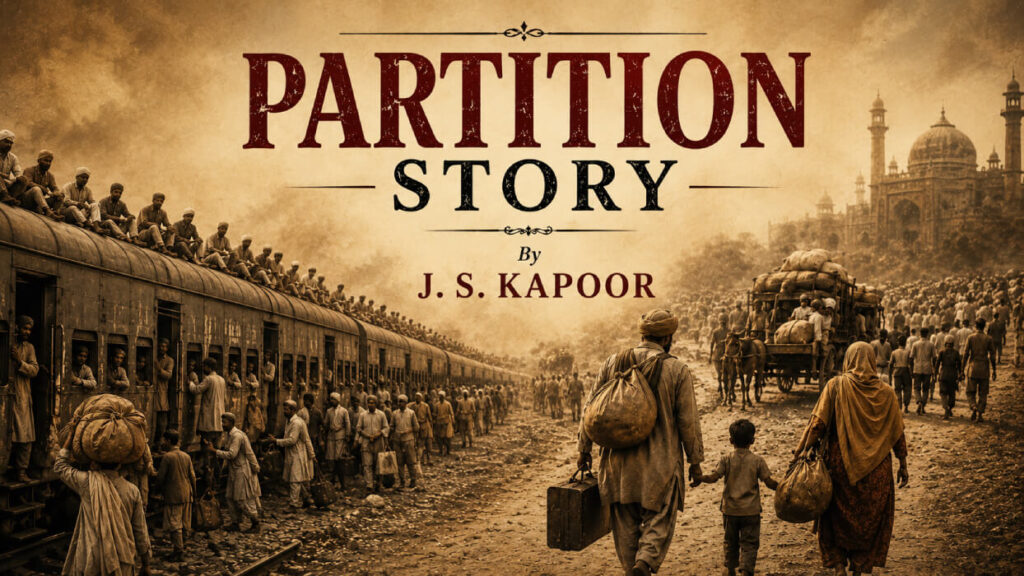
CHAPTER 1
It was wintry day of December 1935 at Hafizabad (West Pakistan) the cold wave was in the full swing, most of the human beings as well as animals had tugged their heads within their legs and were braving the weather with the help of charcoal or wood burning.
In the house of Chaudhry Narain Das Kapoor in Mohalla Kapooran (Samadhi Mohalla) a number of family members had gathered and there was lot of hustle& bustle – the gents were sitting in the living room munching Groundnut & Gur and enjoying the warmth of the burning of the charcoal whereas the ladies clustered around the big fire in the huge veranda of the house talking very slowly unlike the habit of the women and their faces depicting great anxiety. The clock struck 11 night and there was noise in a room and lot of Stir and the two women coming out and going into the room frequently fetching one or the other item. Around 11.35 am one women came out of the room and said (Wadhain, Kaka Hua Aye) congratulations, male child is born. Immediately there was demonstration of joy in both the clusters i.e. women as well as men, the young girls and boys showed lot of pleasure by banging the kitchen plates with spoons. Almost after an hour Dr. Veeran normally called Veeran Bhuawa came out and said “bhai sahib wadian sab theek hae Bacha takra ae ate bara pyara ae te hunliawmethian” – by that time all the men had also joined the women folk. Chaudhry sahib pulled some currency from his pocket gave to Dr. Veeran and the Sweets distribution and celebrations started.
This son was Ch. Narain Das &Kesran Dai Kapoor’s 15th child and after four consecutive girls hence was very precious and sought for male child in the family.
The child was very dear for the family hence the mother being over conscious started eating hot items on the advice of old ladies, resulting into acute digestion problem to the child and to the mother, none of the medicine was helping in cure. In those days one Hakim (Sadhu) was camping in the Shiv Mandir and was famous for treatment of chronic diseases hence the family approached him who said, “Do not worry only give the child goat milk for a couple of months and give grinded Souaf with sugar to mother and a little of Souaf boiled water to the child.” Accordingly, the goat milk was arranged and the child was fed on goat milk for about two months and slowly shifted totally on to mothers’ milk and Buffalos milk. The child grew very healthy and used to take much more milk than the in take of normal children. It is said that Chaudhrani Kesran Dai would not tell the quantity of milk taken by his child to any one, fearing evil spirit.
CHAPTER 2
Hafizabad is an ancient city, and is home of one of the most amazing canal networks in the world. It is situated at a height of 800 feet (240 m) above sea-level and is located between 32°-20′ north latitudes and 73°-12′ and 73°-46′ east longitude. It is 90 km away from Provincial Capital Lahore. The Chenab River forms its Northern and North-Western Boundary on the North-West it touches Mandi Bahauddin, on the South lays Sheikhupura, on the West Sargodha and Jhang districts and on the East Gujranwala District.
There are a number of stories about establishment of the town but the most believed story is that Emperor Akbar was on hunting and got separated in the jungle from his team and felt extremely thirsty.
Emperor after lot of search spotted one light at a distance and on reaching the spot found a hermit sitting in the hut to whom he told about his thirst. The hermit called the deer, grazing nearby and offered their milk to the king. The king was very happy and asked the hermit to demand something from him on which the hermit desired that nearby a town be build for the convenience of his disciple and the king readily agreed and the town by the name Hafizabad was established.
Ch. Narain Das was a big landlord, a great hunter, a popular social figure and adorned with number of titles from the Government and was living in Mohala Kapooran.
Later in the year-the family shifted to a big house in Mohalla Buban Bukhari where huge stable was adjoining the dwelling, having one big door and an opening through one standard door from the house.
The stable used to have minimum two Buffaloes, two horses-one far riding and other far bringing fodder etc. for animals. The Buffaloes had to be milked by family member only, instruction was that one must have (tharan) direct milk in the mouth and a pat to the animal at the end-Chaudhry Sahib used to say that the process is to inculcate love with the animal. The young ones of the family used to stand in turn for filling their glass with milk-the size of the glass would change with age/capacity of the child.
CHAPTER 3
I was simply one-year-old when my father and the elder brothers started putting me on the back of the horse as well on the buffalo and slowly taking for ride and later for the driving of Tonga/ cart.
At five years of age I was fully trained to administer Chhach (butter milk) with mustered oil to young calves.
It is told that I was brought up by the elder sisters and mainly the unmarried elder sister Dayamanti. Basically, mother had not much responsibility for my development.
I grew a handsome, lovely and much pampered child by the large family, so much so all the brothers, sisters used to give temptation of gifts etc. to sleep with them.
Playing with the immediate elder sisters Kamla and Bimla, and nephews I attained my four plus years of age and the time was to get admitted in the school, at that time there was no choice of school since there were only Government Primary Schools. The primary school was situated nearby but Chaudhry sahib and Brother Jagdish Singh took me to a well adjoining the main bazaar where Pandha (Pandit) performed some puja and then I was got admitted in the school on the circular road. I studied here unto fourth class under different teachers and the head master Mr. Jagannath. In the School I am unable to recollect any remember able event but for that before the start and the close of the school we used to play. The games generally played were Kabaddi, by making boundary through school bags and shoes and regular fighting by Takhti (a piece of wood for writing).
During this period there were three Kapoor children in the school, Devinder Singh, Joginder Singh (Me) and Hardev and all had nick name kaka. The Lassi (chaach) with plenty of butter used to be brought from these houses for the masters. Study in the school was very little unlike today’s system and typically before the close of the school there used to be reciting of parhas (Tables) in each class by dividing the class in two groups. There used to be regular, best handwriting competition on every Saturday, the writing used to be on the wooden pieces (Takhti) and pen (Kalam) of kana ( ), the teacher used to make/ sharpen with his knife, purchased/ replaced with collection of money from the students. All the teachers used to keep a stick in hand which could be taken as the identity and frequently used on the children for not doing homework and mischief. The stick would also get broken and the teacher would get the same replaced through collection.
In the evening the games played in our big courtyard within family children used to be play tarkla salai, khotian (Donkey) pithu, Shatapu and seasonally/occasionally inhaling of naswar ( ) in competition and resultantly loud sneezing (considered good for clearing nose and throat). Eating of fresh/hot roasted gram (hoolan) sitting in circle on low height stools (moorha) was cherished seasonal fun.
At night in the street the games were pakaranpakrai, uchnich, chupanchhupai which was played by boys and girls together in the street.
Big boys used to play kabbadi, wrestling, volleyball, Khutian improvised hockey, gulidanda etc. in the ground nearby, in the evenings. In winter early morning game used to be (maranmarai) catch the ball and hit the one you can with ball.
In addition to the above games some boys used to compete for race of the cow calves- once I got seriously hurt outside the ground of my elder brother’s in laws at Katal Garh . Horse riding and cart/tonga driving and regular competition of the same were other special hobby of some people.
As I am Concerned I grew up to be a very good rider and would compete and challenge any one even elder on the road and would attract enormous complaints of my fast driving of the horse. Different people used to picturesque before my mother and sisters that I drive so fast that become invisible on the back of the horse emanating fear & big shock to viewers, hence do not allow me the horse independently.
My mother afraid of my being hurt and extreme love would scold me every evening on my coming back (tariantunganbhandaiagi agar tu kal godalaekegaya) by saying I would break your legs if you go on the horse again.
My father being a bold man would say that the boys grow only getting hurt (Munde dhigdhigke hi vade hunde nae) and the show went on in spite of the swear opposition of my mother.
The next training was administering curd milk mixed with mustard oil to the calves of buffaloes in their mouth through Bamboo tube and accompany the elder brothers to assist them to train the horses for tonga/cart and learning driving of Tonga.
The final learning in this context and my interest was to give masalla (improvised medicine) to the horse in his mouth— an extremely difficult/expert and brave act by a child).
In the year 1944 I passed 4th standard and got admitted in 5th standard in Arya High School which was around two kilometres from our house. Almost all the students used to go on foot and wearing a head gear was compulsory and very strictly administered by the Head master Dina Nath and PT master Shadi lal.
In the year 2011, I visited Pakistan and paid a visit to the school which is now a Government Girls High School. Here I was given warm welcome, taken around the school which had some extension and very well maintained. Here I could recognise my class which was in the same room, I addressed the students who were extremely happy. I vividly remembered some incidences like my missing the classes for jumping over the rivulet at the back of the school with my friends specially Prithvi Raj Chopra and once I fell in the Nala, spoiled my clothes and as a result got beating from school and scolding from home.
The school was out of the city and on the way a number of Ashrams were situated where basic facilities like– could be had if needed. At the end of the school curriculum, there used to be on routine mutual fights – it looked as if these were only mock exercises and none of the elders will interfere, even the teachers will pass by saying (nalarumundeo, mud jao) stop, do not fight—This was the harmony& culture of my city.
CHAPTER 4
Lahore Visit.
It was the summer of year 1945 when my father decided to go to Lahore for pursuing and expediting the issue of permit for sweatner much needed for our Soda Water Factory. My Bhua Ji (fathers’ sister) lived there and I had my summer vacations hence my father agreed to take me along to meet Bhua Ji and family and sightseeing in Lahore. We boarded the train from Hafizabad and dropped at Badamibagh /Shadara Rly. station which was quite near to Bhuwaji’s house. It was Scorching heat and no conveyance available resultantly we had to go on foot and on the way quenching of thrust through Kulfi Malai Wali.
We reached home tired and exhausted and met Bhua Ji and her son Kuldeep Nath and later joined by Phuper Ji (uncle). We exchanged pleasantries and hazards of the travel, had refreshing drink and snacks and were taken to the shop just opposite the house where my uncle Som Nath Kapoor and My cousin Kailash Nath greeted us warmly.
Kuldeep Nath took me to the nearby market from where we bought some eatables and kites and its’ accessories and went back home on its’ roof top to fly kites.
We took dinner together but my father’s dinner came from the hotel nearby since he was not to eat anything from his younger sister’s house. however we all enjoyed his dishes.
I and Kuldeep slept together and almost whole night talked about Lahore its’s special eateries, Museum, Zoo and monuments– Very thrilling Little is known of the history of settlement of Lahore prior to Muslim period. .Hindu legend attribute the founding of Lahore to Lava son of Rama.
The Lahore is situated 31.15 N and 74.
E. and is bounded on the North and West by the Shekhpura District, on the East Wagah and on South Kasur District. The Ravi blows on the Northern side of Lahore. Amritsar is 50 KM,Wagah28 KM, and my Hafizabad 90 KM from Lahore.
The city had a turbulent history, it was the capital of the Ghaznavid dynasty from 1163-1186 and after his decline, Mongol army attacked Lahore in 1240. The city was repeatedly attacked by the Mongols untill it fell under the Turkie Emperor Timur in 1324 and was captured by Mughal emperor Babur, this marked beginning of Lahore’s golden period under Mughal dynasty. Lahore was greatly expanded during the reign of Shah Jhan1628-58 but declined in importance during the reign of his successor Aurangzeb.
After the death of Aurangzeb Lahore was subject to power struggle between Mughal and Sikhs–with invasion of Nader Shah in the mid18th century, Lahore became an outpost of Iranian Empire. However it was associated with rising of Sikhs and became the seat of power of Sikhs. Ranjit Singh Ruled Magnificently 1799–1839 and after his death it was passed under British rule in 1849. When the Indian Sub-continent received independence in 1947, Lahore became capital of Panjab province.
We remained in Lahore for 6-7 days, saw almost all the important places of Lahore and observed the Architect of Lahore i.e uniqueness and variety build by the Mughals, British and Sir Ganga Ram (called father of Lahore). The daily routine followed by us was to get ready early in the morning and go to different places via Anarkali bazar , enjoying the delicacies, variety and uniqueness of it’s food. We visited Lahore fort which was build by Emperor Akhabar, Shalimar Bagh build by King Shah Jahan, Shahi Masjid these were the mind blowing architecture which depicted unique ness and awesome technique of Mughals.
The Gurudwara and Samadhi Maharaja Ranjit Singh were the remarkable monuments build during Sikh period. The general lay out of hospitals and colleges of Lahore by Britishes and Sir Gang Ram were amazing. It would be pertinent to write here that Sir Gaga Ram is considered as the father of Lahore and his magnificent statue is erected at a central place.
The most interesting places for me were Museum and Zoo which were very big, informative and educative and one of the best in joint India. The trip would be ever remembered by me.
CHAPTER 5
Hafizabad was very popular for its Ramlila and there were two separate Ram Lila groups which were in severe competition with each other, almost all residents used to go to witness the Ramlila with family, which was staged at night normally between 8 pm to 12 night, this was one of the best entertainment in those days for about 10 days. We used to play Ramlila in gali peepal wali and the roles of Ram, Laxman and Hanuman used to be played by me, Prithvi Raj , Ram Parkash. Khairaiti Lal strongly claimed to perform the role of Hanuman and on our saying he would not be able to carry both Ram and Laxman, Khairaiti Lal opted for trial to carry both of us, consequently his carrying both of us on his shoulders and running in the street, had a fall hurting Prithvi at the knee resulting in some bleeding and apparently a few scratches to me on the elbow resulting into lot of pain.
I felt much uneasy and left for home where after meals I sat down for the study which could not be possible since I was in acute pain.
Around 10 pm when the pain was unbearable, my arm was excessively swollen and not moving I had no choice but to tell my mother. I told my mother about the injury who immediately opined that I had broken my arm and gave me some pain killer to reduce pain and compelled me to take a glass of hot milk mixed with haldi (Turmeric) and whole family got to know the incidence and were worried. The next day early morning I was taken to Peelo village where a famous bone setter set my arm. How ever after a few weeks when I went for checking, it was perceived that the arm was wrongly set and could only be rectified after breaking joint and resetting the same but my father refused to get it done —the arm is still not straight and there is one-inch difference in the length of both the arms.
My father and mother decided to go to Nanakana Sahib with S. Sewa Singh and his wife on the Gurupurab in the year1946 and on my crying for going with them they did not drop their programme but reposing utmost faith in Baba ji decided to take me along. At Nanakana Sahib there was lot of rush and in the Darshani Deuwadi the mischief mongers used to create commotion and cut pockets and my father was also a victim. The Purse of my father was picked from the internal pocket by cutting his coat and even the picketers took our shoes from the deposit since the shoe slip was in the purse.
It is pertinent to mention that there was extreme rush and nowhere one could move without a push from left & right but my arm was perfectly protected, it looked as if Babaji had declared the area untouchable—Great.
My father reported the incidence of pick pocket to the Gurudwara management who had well managed and elaborate arrangement, had caught a number of thieves/pickpocketiers and recovered from them lot of purses and other items but our purse could not be traced.
Our family was large and three sisters and one brother was married and the custom was that the daughters with their children would come to live with their parents for almost whole vacations hence we used to have large number of children together, playing together in our huge court yard and the boys also playing outside. The big cluster of my nephews and nieces some of them elder to me was a threat and encroachment on my rights, they would even snatch my own toys – but a great fun. Later my deceased sister Kaushalya’s son Madan Lal stayed permanently with us and another sister also settled at Hafizabad and this fun and encroachments continued. All my nephew and nieces used to tease me by calling “Mama” but never any one outsider could dare to say so- this was our fear/prestige and family unity.
CHAPTER 6
My elder brother Jagdish Singh’s marriage was in April 1947 and I along with my brother Iqbal Singh went to Kaulu Tarar for bringing the white mare. It was around noon that we reached at the village and saw Attaullah Tarar Sahib inspecting the grooming of the mare and getting shoes fixed to his bulls. Attaullah Sahib gave us warm welcome, served us Chach (cured milk) with plenty of butter and after making us comfortable said “Ghori Tyar Hai.
The mare is ready. The mare was of pure white colour, very robust and not being used for a number of days and being given special diet to make her better runner. I requested my brother to let me ride on the mare which my brother readily agreed. However, Attaullah Sahib told that mare was difficult to manage/ ride, hence it is not safe for the child to ride on. My brother looked at my face and assured Attaullah Sahib that I was a very good rider and nothing will happen to me. Ultimately the mare was given to me and in reality she was damn strong and naughty.
The mare first had lot of erratic dance then stretched her legs, made her stationery and refused to move and after the beating by Malik Sahib all of a sudden she ran into the Dera (Shed) which was of low height, probably with the intention to harm the rider—my head could be chopped of. All the gathering at the Dera got afraid, started praying God for my safety. However it was to their surprise and amusement, I clinked to the neck of the mare catching the bridal just near her mouth, hence no harm could be done to me and the mare had to come out from the other side of Dera unsuccessful, to obey my command.
Everybody there appreciated my courage and skill and blessed me.
Attaullah Sahib was very happy and proud and could not resist his emotions said ‘” Ae Mere Bhera Chaudhry Da Putar Ae, Ae koi kararthurahai” (He is son of my brother Chaudhry and not a bania), He came running and kissed my forehead – what a great love.
CHAPTER 7
Hafizabad people were strong & hard working, lively, hilarious, full of vigour, liberal, and people of parties & celebrations and embodiment of harmonious & lively culture, Hindu & Muslim were basically from the same race, had almost no religious strife and used to celebrate their functions& festivals together throughout the year with great enthusiasm like Deepawali, Dussehra, Id, Muhuram, Lohri, Baisakhi etc. in addition to some fairs, nautanki, toorantalki etc. The Animal fair of Hafizabad generally was held in the month of March. It used to be the biggest fair in the Lahore division with elaborate arrangements of entertainment; the main attraction here used to be drama, nautanki, circus etc. Various sports viz wrestling, kabbadi, catching of wrist etc. were also played. The aristocratic/ chivalrous game of polo/ peg lifting was exhibited with great enthusiasm in which generally the winner used to be Malik Feroz Khan Awan, Ch. Narain Das Kapur, S.
Bhadur Singh kalianwale.
Another very popular event was Dusehra celebration, burning of Ravana and his family after completion of Ram Lila in the huge Idgah ground (land donated by Dewan Harikishan Kapur). Here all men, children and some women from all religious faith from the town and surroundings through all mode of transport used to come to see the event. The craze was to take home some piece of bamboo stick used in the body of the Ravana, since the same was considered very auspicious and lucky.
In the year 1946 after riots in Calcutta, UP, the religious harmony to some extent got jeopardised in Hafizabad also and the Hindu and Muslim organisations like RSS, Muslim league, Akali Dal got active and started grouping and strengthening, holding secret meetings etc.
The people also started gathering weapons for their safety and erecting iron gates. However most of the people were not much scared and were of the opinion that they would not leave their houses even though Pakistan.
The Mohalla Babben Bukhari was totally Muslim area and only three Hindu families used to live in the area, where as two other families i.e.
Amar Nath Chopra (Rtd. Inspector police) and Hans Raj Bhandari shifted somewhere else. Our family was lone family living at the time undaunted by the circumstances and braving dangerous rumours, but internally very conscious and had made elaborate arrangements like keeping of weapons whole night vigil etc. The house was amidst the Muslims and some people used to come for listening radio news and would even discuss their planning etc. before us, as if we were in their group.
In the schools telling proudly concocted stories about possessing of different weapons and there use to friends proudly had become very common pass time activity.
CHAPTER 8
The trouble in Hafizabad started on 13th August 1947 when some shops were set on fire, and our school mercilessly burnt and looted.
In the early hours of 15thAugust 1947 two brothers, Moolraj and Vasdev got slaughtered near our house which partially I witnessed and other two Sardari lal and Satpal were saved by putting them against the wall and standing before them as a joint. Chaudhry Sahib scolded the miscreants who because of respect and shame ran away hiding their faces.
At about 9am an ocean of people from all around Hafizabad gathered along the railway line opposite Gurudwara Chavi Padshahi with the attention to hoist Pakistan flag on the Gurudwara which was resisted by Sikhs and there was exchange of fire between Sikhs/Nihang and Muslims accompanied by police. After some time of exchange of fire, police and Muslim leaders visualised the ammunition, strength and courage of the Sikhs hence decided to retreat and the crowd went towards Mohalla Kapooran but this Mohalla again had good defence under the control of Dewan Ram Nath Kapoor recently retired Superintendent of Police.
The Muslim elders due to past harmony/mutual respect or any other reason advised the crowd to retreat from there also and finally the crowd had procession in the main bazaar—this was clearly visible from the roof of our house.
The aftermath of the incidence of 15th August where my father saved two brethren Satpaul and Sardari lal by putting them against the wall and standing before them with his huge body like a giant however Mool Raj and Vasdev could not be saved. some other incidences and advice of family friends like Malik Alibhadur (president Muslim league and Pegh Vend Brother moreover the muslim refugees had come to Hafizabad and tension prevailed. the family decided to shift to our house in Mohalla Kapooran and ultimately go to India and accordingly we shifted in last week of August.
CHAPTER 9
We boarded the truck on 23rd of –September 1947 with 600 to 700 Hindu & Sikhs to go to India. The Trucks were parked on the circular road and a number of good Muslims were gathered there with tears in the eyes to bid good bye to their Hindu brethren. Taking along food grains was strictly prohibited but Shabir Husain, and Chacha Karim brought a bag of about 40 kg wheat flour and sneaked the same under our luggage saying it may be of extreme need.
The convoy commander was one major Khanna belonging to Hafizabad and was very alert and careful, the convoy continued till a few miles before Shahdara without any hurdle, where it stopped abruptly. The commander called, the Representative from each truck and the drivers, and briefed them about the sensitivity of Shadara area, told them that they were going through very sensitive area and ordered everyone to drive bumper to bumper and not to stop on the way under any circumstances. He also instructed who so ever knows driving should sit with the driver at the front seat and in case of any disobedience /mischief push the driver out and take on to the driving.
He put one army jeep in front and one at the back and put some soldiers on some trucks in the middle in alert position.
The situation beyond Shahdara ie border area was again assessed by the commander most vulnerable hence decided not to cross the Wagah border on the day and diverted the convoy towards Lahore DAV college camp and wait for the right moment; here we remained in the camp for six days. The ration in the camp was very meagre only roasted grams and boiled wheat were distributed in limited quantity resultantly the wheat flour given to us by our well-wishers was of great help and to wipe the tears of some other children.
Finally, on 30th Sept. we again boarded the Army trucks to proceed to Amritsar under utmost fear as per the previous reports of massacre and every one was sitting in the trucks like a duck. The convoy crossed the Wagah border in the evening and seeing the Indian flag every one sitting like a duck, engrossed with fears, suddenly stood up and started raising slogans “Hindustan Zindabad” etc. and for the moment every atrocity, hardship, difficulty was forgotten.
The convoy stopped 3-4 miles before Amritsar and we were asked to unload; here a number of persons who had reached India earlier were searching for their relations. In our case my uncle Dewan Paras Ram Kapur and my eldest brother Ch. Inder Singh Kapur, who had come earlier through Jammu spotted us and took us to Sharifpura where they had occupied a house. We reached the house around 10 pm and had nothing to eat, however a little quantity of rice was available with us which could be boiled by burning Chhaj (used for separating wheat from hay) and distributed to all the family members.
Early morning lots of mourning sounds were heard and on enquiry it was found that cholera epidemic was in full swing in the area. My mother who was a strong lady got extremely worried and gave ultimatum to the elders of the family to shift to any other safe place even open ground and till then no cooking or eating would be done.
The elders went in search of some accommodation and could find some local contact who immediately offered two big Halls as temporary shelter for the family, in Katra Ahluwalia near Golden Temple. The family reached the place, after 11 p m. extremely hungry. The full efforts were put in to find some food to eat but were of no use, since all the shops were closed. Lastly our elders went to Golden temple and found some chapattis and dal from the Baba Tul and the same were distributed. we lived in Amritsar for 10-15 days, bathing in the Sarover and daily Ardas at Harmandir Sahib.
CHAPTER 10
After reaching India the challenge before every one was to find a shelter and livelihood, accordingly everyone wanted to settle at the place where one had relations/ contacts/ earning opportunity or the metropolitan cities. My father, Brother –in- law, two brothers went to Delhi to look for some shelter etc. since we had very close relations settled there but were disappointed with their cold response and decided not to live in Delhi. During these days, there were no regular passenger trains or buses operating hence they took up one goods train which stopped at Panipat, where they happen to meet an old acquaintance/ relation who welcomed them with warmth and got my brother Ch. Jagdish Singh employed in blanket finishing factory as clerk on rupees 60 per month which was of great help and the family decided to settle at Panipat.
Accordingly Ch. Inder Singh & Ch. Jagdish Singh remained at Panipat and others proceeded for Amritsar to bring the family.
Panipat is an historical & ancient city, 90 km north from Delhi and 169km south of Chandigarh on NH-1, where three battles were fought in 1526, 1556, and 1761which were turning points in Indian history. The first battle was fought between Mughal Chief Baber and Delhi Sultan Ibrahim Lodhi. The second battle was between Mughal Baryam Khan, the guardian of young Mughal emperor Akbar and Hemo.
The third battle was fought between the Maharatha army under Bhao Sahib and Ahmed Shah Durani.
The city is now famous for textile – bed covers, bed sheet, blankets, carpets; it is biggest centre of “Shoddy yarn”. ”Achar Pachranga of Panipat is well known Indian pickle, Panipat also has heavy industries with a refinery of Indian Oil Corporation, National thermal power corporation plant. The main places of attraction in Panipat are Museum, Tomb of Ibrahim Lodhi, Kabuli Bagh, Devi Mandir, Kala Amb, Salar Gate and Tomb of saint Bu Ali Shah Qalander and Rama Sharnam.
The whole family as per schedule reached Panipat, but the city was under curfew as the result of riots hence we had to stay at the railway station for 6-7 days under one Shesham tree, cooking whatsoever available and eating the same in the open – horrible.
At the railway plat form the anxiety and pass time activity for us all was to look for relatives/ known people in the train and this way, a good number of families of Hafizabad and its superb got message that Chaudhry sahib family has decided to settle at Panipat and they also followed suit. Dewan Vashno Dass Kapur (Tya Ji) who was posted as Deputy Collector some time back at Panipat also opted to settle at the place after meeting us. He got a big house allotted in Mohalla Rajputan where we lived all together including a number of other relatives – this was the relations support and culture. Presently Hafizabad people are settled at far of places doing very well in their profession. “Yaron ne ja kay duur basa lee hain bastian Bikhri huye hain pattian jaise gulab ki.”
CHAPTER 11
As mentioned earlier Hafizabad was very popular for Ram lila and there were two clubs functioning i.e Ramlila Gosain and Ramlila Sunarian. The former was under the leadership of Pandit Hargopal and they opted for building Dharamsala at Haridwar known as Ram Bhawan /Hafizabadi for which further funds were also collected. The later started staging Ram lila at Panipat in a magnificent way under the patronage of Dewan Hari Kishan Kapur and Chaudhry Narain Das Kapur. Dewan Chaman Lal Kapur and Chaudhry Jagdish Singh Kapur were its managers. The Ram lila in those days was best way of entertainment and rich people/elite used to go to witness, with their full family even all the ten days of celebration. However, with the change of technology, culture and attitude of the public the stage Ram lilas are the thing of the past.
Biggest challenge before our family now was livelihood (Roti Rozi) and unluckily none in the family had much experience of business. It was a sheer chance we could get one Dhobhi Ghat and started a laundry business in partnership with someone who again had no experience of the business resultantly incurring of loss and the partnership broke and some viability was obtained by my brothers Ch. Jagdish Singh & Ch. Iqbal Singh with hard work and expert advice. My sister Kamla & I also used to support the business by pressing the clothes at home to save the wages of the press man.
Later the soda water factory was also started, by getting some loan from sister Dayamanti. I and both my elder sisters used to live very amicably I would even save the colliage/pocket allowance and bring Salad item with which we all used to have the food. We had also kept a few hens which were substantial support to serve the eggs to the guests and by selling the same we could bring some other petty items for hospitality for a stream of guests, but the biggest challenge before us was to behave and look aristocrat before the relations and others in spite our meagre income —what a difficult challenge.
Eldest brother Ch, Inder Singh started fruit and vegetable commission business and was living separately with his family, quite often I used to go to his shop and get fruit etc. for the home.
We & Taya ji (Dewan Vaishnoo Das) were also allotted some temporarily agricultural land where it is present Model Town and later we were allotted land at Bich piri. The assignment to bring vegetables from the farm almost daily was of Basheshwar Nath (my cousin) and me and we used to spend lot of time in catching some grazing Donkey behind the S D High School to take to the well to carry vegetables for us, but hardly we would be successful since the donkey would normally get himself free and in the process many times we got injuries also but the fun continued. The permanent allotment of land in lieu of the huge land left in Pakistan is till date a Mistry for me and the younger lot.
I got admission in 7th class in S D High School which was hardly half a kilometre from our house and passed my Matriculation Examination in the year 1952 and before the announcement of the result got employment as a work charge labour on the electricity line being erected between Panipat to Safidon- I was assigned a light job at the beginning i.e. to fill the log sheet of the vehicles, sitting in the camp office but later was put on the miscellaneous labour job and fabrication of transformers on the sight – Here in my employment of about three months I got three significant injuries— Broke my head by a big bolt which fell on my head from the top of the tower while I was cleaning the items at the base of tower on sight, the bleeding was profound and no first aid available hence a piece of cloth was burnt and put on the wound to stop bleeding the small hump is still visible.
The second injury was when I burnt my arm while lifting recently switched of electric motor which was quite heavy.
The third injury was when I cut my index finger of left hand while lifting some parts of the transformer with one co-worker which were heavy, however this cut proved a blessings and life time reminder to me later when in power I always looked at the finger while giving punishment or discharging any employee, and resultantly got popular for counselling and verbal firing to the errant employees.
The matriculation result was out and my father was very happy that I have passed entrance and took me to different big bosses whom he knew well for the job but felt humiliated as I had done only Matriculation and they wanted minimum graduation. I was also taken for the Delhi police for the job of constable, where my father had quite good acquaintance with the top bosses but again I got rejected since I was under age and my weight and chest was also less than the required. The income of the house was very meagre, no college at Panipat, hence it was not possible for me to have college Education.
To do some job to supplement house earning was my utmost necessity.
Ultimately I got employed as a clerk and later worked as typist in Rashk-Ke-Munir Scent manufacturing Company, Phawara Chowk Delhi at rupees 55/ per month with good offices of my uncle Sh. Kidar Nath Barry, and I started living with my dear Bhuwaji & Phupherji (Aunti& Uncle) near Sadar Bazar and used to go & come on foot from Phuwara Chowk, but for some time when I would use tram for some distance by paying one anna (six paise) only with an effort to save money.
I had merely worked for 3-4 months when my uncle Dharambir came to Delhi liked me and took me to Bombay/ Mumbai with a promise to make me manager of his business for which I was damn happy. On reaching Bombay around 10 am I was left at home and asked to rest and on the very next day was put to work i.e. going with uncle around 10 am on local train, working as orderly on the shop.
The lunch used to come from home for every one through dabhawala and I used to get tea in the evening with bhujia then wait till uncle finishes his drink and we chase the last local train to Santa Cruz. The routine was to take taxi and chase the train at all stations and finally catch where so ever possible or otherwise reach home around 11 pm on taxi.
After a few days the routine got changed, I was ordered to stay back at the shed and help Satya Paul in mixing colour till after noon and then catch train and reach shop at Masjid Mor—my goodness all my body, clothes used to emanate colour even the cough was full of different colours .The duty was very hard, had no friend, no sympathiser and over and above another bolt from my chachi ji (Aunty) that I should bring milk from the booth early morning instead Satya Paul ( her sister’s son), which was beyond my capacity but was helpless- poor lone fellow. However, I choose to inform my uncle in a way that Aunty does not get annoyed i.e. one day I on the pretext of finding empty bottles started making rattling sound and on enquiring, uncle got to know that I was deployed to bring the milk also, he was very angry with chachi ji for this excessive work load on me, and instructed her to relieve me from the duty immediately.
I could get hardly time for the writing a letter, however I spared some time and replied the letter of my sister saying I am ok but the work hours are too long and work is very hard, various colours are on my body and clothes and I look like a parrot. I cough various colours but do not bother for me and do not reveal this to any one, maybe my role is changed. The letter was like wild fire in the family who loved me so much as my sister immediately read letter to all the family members who went into weeping mode and decided to call me back or someone to go and bring me back. My father immediately wrote to my uncle and gave telegram to send me back immediately; my uncle sent me back and gave me some amount calculated @ 100/ rupees per month as my salary.
I reached home and on perception family found me more effected than even communicated to the sister, the rectification process was started clothes were bleached and some thrown, Doctor was consulted who found slight fever and acute weakness hence was administered medicine and recommended rest and as a result was fit to fight again in about a month.
My brother Ch. Jagdish Singh had started poultry farm along with his service in Panipat municipality, in partnership with one Karamchand.
The farm was mismanaged due to lack of supervision and finance and I was assigned the vital role, which I effectively performed for some time and further losses could be saved.
Ch. Jagdish Singh later got contract of transporting Ice from the local Ice factory to its various Depots at Panipat city and delivery was strictly time bound. To execute the contract my brother bought four horses with carts and employed four drivers but generally there would be absenteeism and he would be short of a driver, hence the poor me had to come to the rescue. My modes operandi was to create a buffer stock at the depot by conducting 3-4 rounds before dawn so that none knows that this menial work is done by son of the respected Chaudhry family.
CHAPTER 12
In the year 1954 Arya College was started at Panipat and I was working at the English wine shop at rupees 60 per month. My brothers now were financially better specially Iqbal Singh who was working with his father- in- law on salary cum share basis, Ch.
Inder Singh also joined the wine business, Jagdish Singh was working with the Municipality.
I requested my brothers to get me admitted in the college which was agreed with the consent of L. Jagan Nath, on the condition that my job shall be performed by my father helped by me, and I will get rupees thirty per month i.e. Iqbal Singh rupees 15 and other two brothers 7.50 each. The college fee was rupees 13.50 per month and my regular receipt was rupees 15 per month and erratic payment of rupees 7.50 per month, the third brother could hardly afford to pay since he was helping the family otherwise and living in the same house. The family had big status in the city hence I had to pose belonging to a royal family —what a paradox and extremely difficult role.
It was sheer chance or compromise of convenience that I develop friendship with Gulshan Bajaj, Surinder Sehgal, Des raj Khera, Kuldeep Sharma, Girdhar Gopal accountant etc. We used to catch hold of co- students and get their fee deposited with fine waived using our influence and the concerned would spend for our extra expenses and some would spend voluntarily on us for reason known to them only. I and Surinder Paul were serious for studies, would read the subject in advance and be only in the class to clarify the doubts etc, and used to bombard questions, resultantly the teachers would get irritated —It would be pertinent to write here that in spite our nefarious activities we both friends were topers. Our reputation & strength was a matter of jealousy for the other group consisting of Karan Singh and Kadar Singh and some of our relations and friends used to take liberty like my distant cousin Qemti Lal and nephew Surinder Kumar whose ragging of a boy of the other group led to a serious group fight from where they themselves fled away and we were in the soup- I had serious head injury and injuries on the arm.
The criminal case was got registered by the college authorities under various sections which was later got amicably settled by the good offices of Sh. Amrit Lal Batra , Dharam Singh Rathi, Kundun Lal Lamba, Dewan Chand Takker etc.
At this point of time none of our male member was stationed at Pani Pat hence my nephew Rajinder Chopra gave telegram to my brother Ch. Inder Singh “Mama fought with college students, admitted in hospital”.
The telegram was delivered at noon when my brother, who was at Rewari was going to start eating his lunch, which he could not and abruptly, preceded for Panipat—great Love.
On reaching Panipat my brother saw me in the bazar with bandages coming from hospital felt sigh of relief, blessed me and said “Kaka Hun Te Bhut Bukh Lagi Hae Aa Kuch Kha lye, baki galan phir karage” Ch. Inder Singh met the different people who were helping us including Nathu Shah with whom we had strained relations but he pleasingly helped us due to Gulshan Bajaj without discrimination, treating us as children—saying “Bache Sare Apne Nae, Aur Joginder Te mere Sher Inder Singh Da Bhara Hae.” My brother told me about his anxiety and fear for me but did not said any derogatory or reprimanded me for the episode and only said “ Izat De Lae Ladaye Karna Te Sadi Family De Khun Wich Hae” prestige fights are our family trait. He took me to a meat shop paid the butcher price of 15 chickens and instructed me to take one chicken daily for my consumption.
The reconciliatory meetings between the two groups used to be held at the houses/offices of the above mentioned elders and Dharam Singh Rathi was honorary advocate for both the groups. All mentioned people used to treat us like their own family members and feed us sumptuously with love. Mr. Rathi brilliantly and dedicatedly pleaded our case and when asked for professional fee, he scolded us and virtually gave a mild slap to me saying how I could dare to say –what a great character love & culture – I vividly remember and feel the pinch/pleasure of that slap.
After this great fight my mother and my aunty (mother of Surinder) got afraid, which was obvious since all the elder male members of both of us were working out of Pani pat and decided that we both should be taken out of Panipat so that we shun the bad company.
However, I could convince my family to let me continue my studies at Panipat with my promise to be cool/submissive for rest of the period and leave/ reduce the company of Gulshan Bajaj etc.
However, Surinder’s mother went to her cousin Sh. B N Puri then General Manager of Punjab National Bank, related her problem, who promised her to get Surinder appointed in the bank and advised to send his son in his office. The very next day we both went to the office of Sh. B N Puri who telephoned Sh. Bagga, then Secretary State Bank of India and instructed us to see Sh. Bagga in his house next Sunday with bio- data which we did. Sh. Bagga (who again was family relation) warmly received us in his house and took the papers. He asked me for my papers but on saying I would continue my studies, was very happy. The letter was received by Surinder from State Bank of India Rohtak branch for an interview in the very next week. The interview was on Saturday and Surinder requested me to accompany him to Rohtak where after formal interview and test, he was asked to join the duty. I kept on sitting in a nearby restaurant enjoying coffee where as by working two hours only Surinder got salary for two days—great pleasure.
Surinder left the college and I was deprived of my Sweat Company, study friend and well wisher. However, I found respite in another nice gentle fellow Gurbaksh Singh Sehgal who fully fulfilled major gap; Gurbaksh was very gentle, punctual, methodical and serious for the study/ carrier and used to live quite near to our house. Very sad he died very young while he was working as head master in a school at Patna(Bihar).
The election of the college was scheduled in the year 1957 and our group decided & compelled me to contest for the secretary position since I was considered as balanced and cool person in the group. On learning the news my father told my mother that I was called tiger in the college and was contesting the election which he would loose badly since the same is by secret ballot. My friends assessed that we would win with thumbing majority hence arranged for the procession but the result was totally different. The winning party out of fear/ respect put the first garland around my neck, on which my friends termed the action as very offensive and wanted to take revenge, but I was averse to the same and could only cool/convince my friends by saying that the action on the day would bring defame to us and the revenge can be taken later and this way the fight was averted for ever.
The winter in the year 1956 was very swear and some of us (stalwarts) had no proper woollen clothes hence we decided that this winter none of us would wear woollen and moreover two button of the shirt will also remain open- this all had to be kept secret from the family. The brothers got me beautiful coat from the rags, sold at Jama masjid but the same could be identified as used /bought from rags as it had half lining unlike the custom in India. I used to wear the coat with great pride but refrain from putting it off in public.
I have lived my life in all the situations and never regretted or cribbed because of extreme love, recognition extended to me by my whole family.
Though I was youngest in the family and still adolescent, even then was considered unchallenged evidence, consulted on major decisions and even used to be mediator, problem solver/ fight reconciliatory within the family.
I learnt/gained a lot from my family and had basically my five mentors i.e. my father, my mother and brothers: My father taught me to have utmost faith in God, to be fair and bold, help the poor, lead a graceful life and be content and thankful to God, and used to utter always “Karam Tera, Rahim Tera, Fazil Tera.”
My mother taught me strict discipline, contentment, sacrifice for the family and be religious.
My elder brother taught me bravery, not to accept one without scrutiny, must react/ fighting spirit and virtual fighting tactics.
Ch. Jagdish Singh taught me to have patience, emotional love for the family, sacrifice for near& dear ones and vigorously pursuit of Hobby.
Ch. Iqbal Singh taught me concern for the family, business traits, help the needy relatives, keep up family prestige and honour the promises.
I always used to spend my summer vacation with Iqbal Singh who have been sharing business and teaching me its intricacies—was of much help in life.
The family was large, the families of married sisters living in the town, meagre income, great prestige and honour- what a difficult paradox but I perused it with the cooperation and love of whole family.
There are numerous related instances/ stories but I have enumerated a few of them only.
Kuch Baat Hae Hum Mae Ki Mitti Nehi Hasti Humari – Aziz Ullahpur was around five miles of distance from Panipat where our very close friend Kuldeep Sharma’s father who retired as SP police had made his banglow within his own land away from the village with modern amenities and facilities. Kuldeep Sharma has been persistently insisting to spend one night in that beautiful and different atmosphere.
It was the month of May 1957 when Gulshan Bajaj, Des Raj Khera, Surinder Sehgal and me went to the place with Kuldeep Sharma on bicycles and reached the village when dark. The short journey with friends on kacha road into the vast land without any inhabitation was a new experience and adventuress.
The magnificently situated single banglow with its beautiful lighting was looking marvellous. Pt. Lakhpat Rai Sharma (father) and 0 brothers Shashi Rai, Ranjeet Rai welcomed us with great love and we had great fun and sumptuous dinner in that natural beautiful surroundings. The fun, activities, remember able hospitality was so great that we did not realise it was pass ten pm and Surinder Paul insisted to go back since he had not told his mother that he would stay here for the night.
I passed my graduation in the year 1958 with top position in Economics and later the degree was received from the hands of Honourable, Sh. Lal Bhadur Shastri (very simple and honest prime minister of India) in the convocation, for which I am very proud.
My brothers who were now financially better, especially Ch. Iqbal Singh, asked for my future planning on which I expressed my desire for higher studies in case I do not face the crunch of normal expense and the same is given to me through one source. My father was of the opinion that I should start earning but Ch. Iqbal Singh immediately agreed to bear all my expenses solely which was a matter of pride / joy for me. The total family was together on the day and we had a very pleasant & sumptuous dinner together, and exchanged pleasantry till late in night. However, I was awake almost whole night counting the amount of love and sacrifice of the family for me and was extremely thankful to almighty for his kindness to pull me from the deadliest position/s I was placed and make my further travel of life easier.
The very next day on the advice of my elders I proceeded to Delhi to get advice for finalising the course of higher study in consultation with my uncle ( Phupher ji) Sh. Kidar Nath Barry who was considered to be the most knowledgeable and enlightened man in the family.
Uncle advised me for pursuing the comparatively new field i.e.
Chartered Accountancy and we made extensive enquiries and searched for the seat for articles which could be located with Mohinder Puri & Co Connaught Palace, who accepted to give me articles on the condition, we deposit an amount of rupees 5000 as security with him and a nominal stipend would be paid to me during the period of my articles.
I went to Roper where my brother & father had wine contracts, for getting the amount for the deposit, which was given to me through blank cheque with advise to request Mohinder Puri (who was again a distant relation) to have minimum amount.
Reaching Delhi I kept my luggage at bhuwaji’s house and straight went to Mohinder Puri’s office but lucky or otherwise he was not in the office and I went to Rameshwar Bahri (My Nephew) who was working with Irvin Hospital at that period of time. Rameshwar apprised me that my detailed marks sheet was received and I had top ranking marks in the economics in which I wanted admission and he suggested me to take admission in the economics in Delhi School of Economics, in which my nephew Sarv Malhotra had already taken admission. He convinced me to leave the idea of perusing CA which was not in line with my temperament as self respecting and bit adamant person would not be able to serve as subordinate for four years. The next day which was probably the last day of admission I went to the university and got the admission in Economics.
I started living with my Bhuwaji (fathers’ sister), uncle and my cousins Kuldeep Nath and Kulyash Nath in their small house. I used to go to the university on the bicycle and in the beginning felt very difficult to adjust in the class, due to co-education, difficulty in understanding of English accent of the teachers and bearing of hypocrisy of the Delhi students. More over the toppers of almost all the universities of India and even abroad students had taken the admission in this university, making the study very competitive. At a point of time we got so much frustrated that I went to Punjab University Chandigarh for migration, where on looking at the marks the Dean of the university, immediately agreed to give me his special approval but I did not accept the same, since the atmosphere and faculty of Delhi was marvellous—worlds best and Punjab university was in no comparison.
The living in bhuwaji’s house in the company of my dearest cousins was very pleasurable and hospitality & love of my uncle and aunt unparallel – the house was my second house but the accommodation was very short hence after some time I shifted to a big house of my uncle (Chacha Ji), near old railway station, where my cousin Mohan Lal Kapoor with his friend Gurcharan Lal was living with a servant (Mangal Singh) on sharing basis – a very pleasurable and comfortable stay. However, after some time my cousin shifted to Jullunder and I had no choice but to think of shift at another place.
Sarv (my nephew) was also studying Economics in Delhi School and was feeling difficulty for studies as the accommodation with his brother Rameshwar Bahri was very less and resultantly we both jointly hired one room at Rohtak Road where we could study peacefully and sleep. The house of Rameshwar was near bye and we used to have our food with him; I would never be able to forget the good gesture/ kindness extended by our revered bhabi Janak Rani, she was extremely nice that in spite of her small children would get up in the morning and cook chapattis for both of us which we would take as lunch with water only and later a cup of tea at Ramjas College. The time passed on i.e. Starting for the university on the bicycles from New Rohtak Road in the morning and only coming back late evening after the close of Rana Dey library (Delhi School of Economics).
During the second half of my finals my brother purchased a small house at Paharganj, he got vacated upper portion by giving some amount as pagri and advised me to stay there so that lower portion of the house couldalso be vacated, hence I had no option but to shift there and remain for rest of the period. At this place I develop some lifelong friends like, Pershotam Chopra, Sat Paul Bedi, Krishan Lal Arora, Madan Lal Gaur and Madan MohanVerma. Pershotam Chopra was my co student of economics and my study partner and we both were serious about our studies but We used to go to the university together by bus no 21 and make lot of fun while in the bus and study in the Rana Dey Library of the Delhi school for hours.
While at Paharganj I used to go to Panipat every alternate weak, get my clothes washed and bring a big box of white butter for my consumption.
Pahar Ganj house was surrounded by the relations of my Bhabi Raj Rani (My mother like) and I used to get sweats etc. at every occasion from the residents as her son and was frequently compelled for the meals. I used to keep distance from the young girls/shy but they would often come to my room and gossip and gradually became somewhat friendly. On my passing Master degree all the girls of the street approached my Bhabi for the party which she gladly agreed but on their demand to call me to participate in the treat she replied that I was very shy gentleman and would not come amidst girls— what a joke.
Opposite to the house of M M Verma a family was living who had four young daughters, one night one of them took me at their roof top, where I found all the sisters, who tried to flirt with me but my culture came into the way / got afraid also and on some pretext skipped from there and never went again. At occasions the girls acquainted with me tried to cross the limit but I did not let them do it. At this point of time I was not averse/ afraid of friendship/ gossip with girls was my hobby but was only interested to have pure and simple relationship which I learnt from Pershotam Chopra. In nut shell it would be pertinent to write that girls used to be impressed with us and at occasions would pass great remarks and the poor me has only one- point agenda—carrier and the family culture.
The Paharganj had famous sweat shop of desi ghee of Ram Parshad which was very costly but we all the above mentioned friends who were perusing higher studies and considered scholars, used to go to his shop after dinner, with very limited money available with us and the owner as mark of respect and love for students/ studies used to give liberal sweats and dry fruit as per our demand—what a great attitude.
The friends like Sat Paul Bedi and others used to give me challenge to make a particular girl friend/ talk, which I used to achieve. One such Challenge was thrown to me to make friendship with Poonam who was friendly to our friend Krishan Lal Arora (Archivist) and met me in a party. Very next week there was another function where the girl the demonstrated being good friend of mine. Poonam has been sincere friend to me for a pretty long time and wanted to marry me for which I told her to tell her parents to approach my parents after I get settled—the time never came and still I miss her.
The two years of master of economics passed very peacefully; I used to get the required expenses as per my asking, but I was very judicious in my spending which was crystal clear to the family.
I passed my Masters of Economics in the year 1960 and received degree from the hands of Sarv Pali Dr. Radhakrishnan, Then chancellor of the university. My family was very proud of my achievement, specially my father who would now talk with head high and gladly took me to different known big shots with grace. My father and I went to the big elegant house of Dr. B. N. Chopra (Dr. Chopra was our close relation and the grandson of Dewan Mool Raj Chopra, Raja of Multan) then Economic advisor to Government of India who immediately got me appointed on a temporary job of research assistant. I started looking emphatically for different jobs and would do any job which came in my way, to sustain myself and to quench my long awaited desire for earning. In this period, I worked as part time invigilator for Times of India, Economic tuitions, helping Dr.
Chamberlain for collecting material for his book, teaching in S N DAS GUPTA College, Delhi public College etc. My earning per month was over 1000/ rupees per month which was exorbitant in those days—but unluckily I started finishing these jobs one by one and loosing income and finally left with a lecturer post with Delhi College at rupees 350/ per month.
I would like to mention that my friend Pran Chabrra took me to Manchanda (principal) Delhi Public College Pusa Road for lectures in Economics but the later declined, and on enquiring told Pran Chhabbra that he could not afford to keep faculty which is hand some as well as young for girls sections and there was no vacancy for boys section–What a paradox that one’s good personality becomes a hindrance.
The private tuitions I got through Krishan Kumar Arora, were from elite society and all girls i.e. Inder Kaur daughter of big industrialist, two daughters of SD Verma top official in banking industry, Sudershan daughter of owner of Kaka hotel new Delhi. The girls had interest in me and the parents of most of them were ascertaining my family status.
Some of my friends like Prithvi Raj Chopra got immigration to U K for which I tried but had to drop in the mid, due to lack of support, rather opposition of the family specially my mother who loved me to the extreme and paucity of money to show for obtaining visa.
However I helped my nephew Rajinder Chopra to leave far England.
My father wanted me to join some government job to which I was averse due to less salary and main earning from bribe, however due to his insisting & his high recommendations, I applied for Delhi Police and Central excise and went through the recruitment process just to please him, My appetite for studies/ knowledge and craving for good carrier was not fulfilled and the money was available to me for the purpose (had full support of my brother), hence made enquiries and found a new lucrative area of study, Social Work which was quite paying in India and one could also get immigration to U K, Canada and USA.
The family business was at Gurgaon those days and I approached my brother who gladly agreed my proposal of joining MSW and I applied for the course. I vividly remember the remarks of my dear father- “Iqbal Singh tu enu kharab kar daega hun kum vi karan de su” you will spoil him let him work and settle.” The admission in the school was very tough & competitive but I got the interview call and after passing through various tough interviewing process spreading on two full days got the admission with specialisation of Labour Welfare & Personnel Management (the top ranking Course). The course was very tough and time consuming and it was almost compulsory and in evitable to live in the hostel hence I got the admission in the Jublee Hall – the university’s best post graduate’s hostel for boys.
The life in the Jublee Hall was very good since it had good atmosphere for study, more over to be away from unwanted guests and noise, I opted for top floor. The food and other ancillary services in the hostel were excellent, and now I had no money crunch: I used to get the required money, without any hitch, however my whole family new that I am serious for study and not a spendthrift.
The Delhi School of Social Work was a premier institute in Asia started by YWCA in Lucknow and later shifted to Delhi. It was an autonomous body, oriented towards social work with specialisation of four streams—Labour Welfare & personnel Management, Rural Welfare, Institutional Welfare and Medical Welfare and was awarding Master’s Degree in Social Work. It had only forty seats and was affiliated with Delhi University. The School was a co- education institute with almost equal ratio of boys and girls. The School used to utilise its first two weeks for introduction, socialisation, understanding the class fellows, understanding of school liberal norms & traditions, importance of field work etc. with emphasis on inter-personal relations. The tradition of the school was that every year at least one marriage used to be solemnised between the students. At this point of time I was also acclimatised with co- education and Delhi culture and was popular with girls but was very choosy (considered high head): I took fancy of Mohisini of my class and developed some understanding and wanted to develop friendship, but she left just after orientation programme, never to meet me again, in the juniors I took fancy for two girls –Borde and Kamat who very clearly told me in the very beginning that I was a gentle and handsome boy with great personality but they already had boyfriends. However, I was very friendly, social with all the students and been elected as the president of a few prestigious forums. In the School Bhushan Lal Bhasin ,V S K Sood and me very close friends and as a result even in the formal organised introduction (with nick names and special qualities) of the class we were mentioned in the introduction of V S K Sood; means brave, saint and prince, he is one of the three guess the other two. Bhushan Lal Bhasin later told me that on the very first day when he came to check up his admission he got attracted to me and tacitly offered his friendship that Kapoors are generally handsome and when I was handsome than Miss Kapoor would also be beautiful and he would approach through me but bad luck miss Kapoor was not beautiful.
The school was in barracks and girls hostel was within the school premises and had a small canteen /mess which was run by one couple, called Mosa & Masi who used to cook for the girl hostellers and serve tea etc. to all. The school had strict discipline and punctuality and the gap between two periods used to be very less, hardly one could sip tea but fun was to have one set of tea and share and even sip together from the cup as well as saucer, which looked like a complete family atmosphere.
The study at Delhi School of Social work was very hard, particularly for the labour specialisation under the hard task master and cruel Prof. K N Vaid but was very enjoyable also as there used to be frequent seminars, speeches by renowned speakers, drama, dance, and music and field work, Camp etc— This was part of the curriculum and learning process. Our Annual camp was organised at Alipur under the commandership of Prof. K N Vaid, who made us to work the minutest details and formed the different committees and distributed the duties. It was severe winter and further aggravated by the consistent rain, the tents were uprooted- the Principal Prof. Rane Dey was worried who came with trucks and other vehicles to take the campers back to the school but on basically instigation of Prof. K N Vaid the students refused to go back and decided to face the weather on which the principal was happy on our courage and went back. The challenge before us was to re erect the semi uprooted tents and to concentrate on basically two tents i.e. girls tent and big common tent which the boys saved by holding the pegs by putting stones and sitting over them, while rain was pouring heavily—Courageous and enjoyable. The group completed the duration of the camp successfully and the required work and came to school with laurels.
Professor K N Vaid developed some wrong notion about me that I am high headed, handsome and comparatively less strong/weak for labour field and in the beginning even told my distant cousin APJ Singh Lamba, (remained faculty earlier) about the same. He also told APJ Lamba that he would set me right and make me strong and as a result Professor Vaid always put me with the toughest agencies and toughest task masters like Mr. Chopra Sabzi Mandi, Malhotra, Bata Shoe Co. Faridabad, Dunlop Rubber / Tyre Company Shahganj Calcutta and always assigned me the toughest tasks, which made me tough and high stress bearing personality in life though had to loose marks percentage in the exam.
CHAPTER 13
The examinations were over and the students had to complete 10 weeks of practical training, as part fulfilment of the degree course where I was placed with Dunlop Rubber Co. Shahganj (again the toughest) which was about— kilometre from Calcutta. The place for me was new, climate here was sultry, people absolutely non helping and dry and I was only student placed for field work at this place where at other places the students have been enjoying of togetherness in the company—Vaid Sahib Maan Gae Aapke decision ko ;however I had some references of distant relations and family friends which was a great consolation for finding some accommodation etc.
Kuch Baat hae hum mae ki mitti nehi hasti humari —- I reached Calcutta and straight away from the railway station went to Dunlop Co. Head office, Free School Street, where I was instructed to report to Mr. Stiffle, the training officer at the factory at Sahaganj, which was in suburb of Calcutta/Kolkata about 40 kilometre and one had to go by train till Bandel railway station and from there to Sahaganj by company bus.
The problem before me now was to find some night shelter /stay hence I went to Madan Lal, Qemtilal, and Parkash Chopra (all of them had their business in the same complex) who were relations of my brother-in-law, they warmly welcomed me and everyone wanted to take me with him to his house but Madan lal convinced others to take me with him. Reaching Madan Lal’s house, I saw the family had one big bed room set in a very congested area where he was living with his two kids, the room had one big cot where they compelled me to sleep and all of them slept on the ground in spite my maximum resistance—What a great hospitality. I spent two days with them initially and these days Qemtilal took me for sightseeing and on the next Monday as per the instruction from the school I reported at the factory to the training department.
The training department head Mr. Stiffle briefed me about the factory its rules and regulations applicable on me, gave me some material pertaining to this aspect. He discussed with me about my stay arrangements during the training period and allotted me a bachelor accommodation and authority letter to use the company canteen and the entry card of the factory. Mr Stiffle discussed with me the training programme, the report submitting and my introduction with various department heads but showed his inability of introduction/ time with CEO, and on my request for the same, suggested that in case I had the guts can get time from him directly. A few days after while the CEO was on round of the factory I gathered courage, gave my introduction sought time from him which he allotted at 8.30 am, right on the next day morning before the production meeting and our discussions continued 10-15 minutes after 9 am (regular time of the meeting) this extension made me known as smart guy which gave me privilege for further seeking time with the departmental heads.
Sahaganj was a small town where hardly existed any private business, property in the village including the eateries. Dunlop Company was spread on 239 acres’ land and had modern factory, accommodation for all employees, officers club etc. and a beautiful, modern and highly subsidised canteen but preparations was absolutely Bengali style and not compatible with our taste. The Company had some more summer trainees and a few of their own probationary officers, of Northern India Origin who again had difficulty of food hence often in the evenings we used to go to the bye pass about five km from our dwelling to eat Urd Dal & Tandoori Roti Etc, in Punjabi style from Sheer-e Punjab Dhaba, and would specially get prepared dal and egg omelette and Chulah Chapati from Sardar ji’s a small Dhaba near the factory at lunch. After some days we got another relief in Mathurs – A manager in the factory would frequently invite me and M S Madan for dinner.
The Factory was very neat &clean, greenery all-around, and river Hooghly flowing nearby for transporting and was giving the place a picturesque view. The area was very much prone to malaria, mosquito’s/bed bugs but Dunlop had eradicated this problem fully with efforts of its effective department of over 35 experienced persons. The working schedule in the factory and report writing for the school and copy to the training department for me was quite time consuming and taxing but the company of other trainees, nice surroundings made it pleasant. The company used to remain closed on Saturdays and Sundays and on these days we all trainees, generally would go to explore Calcutta and meet relatives and friends which was again a good change. However, ten weeks training ended and I decided with a few friends to stay back during the last week end at Sahaganj to see the surrounding, enjoy boat and steamer ride and cross the river to see other side town Chinsura etc. On Saturday the clouds were in the sky the climate turned excellent but it was heavy rain in the afternoon and we enjoyed the trip though we got totally wet as we were not carrying umbrella like bengalies. However, one thing I have not forgotten: we went to a restaurant at Chinsura and ordered for meals and were told that there was no meat preparation hence we had no choice but to order vegetarian meals of Bengali style only, but could see a customer being served meat and on our pointing out to the bearer the reply was “It was not meat, it was MASU on this we had a hearty laugh and realised our weakness of not knowing Bengali.
On the last Sunday again we came back quite late at night after sightseeing and was told by the watchman that some family had come to meet me and handed over an envelope embossed over it Dev Dutt Dewan.
I was dead tired but there was also great anxiety to know who was this family which drove from Calcutta to see me and I had never heard of their name, occupied by these thoughts I opened my room flung self on the bed and started reading the contents of the letter which read we are the close relation of your brother’s business links and had come to ask your welfare and invite you to stay at our house while in Calcutta, otherwise let them know my availability and where about so that they could contact.
On the training finished and after receiving farewell party, leaving certificates etc. left for Calcutta. My friend M.S. Madaan suggested me not to go back to Delhi leaving ample job opportunities in Calcutta. He offered me the membership of his close group on the condition I would not ask any money from home, stay with them and they would bear all my genuine expenses till I get a job. The group apprised me about their tried methods of searching job in Calcutta and handed over a note book of addresses of big concerns with the name of their CEO/ MD specially of the north India origin and was told that I would have to daily go in the different direction and meet the officials with CV and report back progress to the group in the evening for further action. I started the mission job search but decided to stay presently with M L Chopra but was fully conscious of their hardship of accommodation and was embarrassment with their giving of utmost respect and hospitality, specially their having only one cot and force me to sleep on the same and all of them sleeping on the floor. However, I had another reference of Som Nath puri (uncle of my friend Surinder Sehgal) chief manager of one of the branches of central bank of India, whom I gave my introduction and apprised him of my where about etc. On the telephone. The man was extremely nice and convinced me to stay with them in their house in Bollyganj where he was staying with his infant daughter and wife which I agreed. – The house was big, well decorated, the hosts were very hospitable informal like own maternal uncle and aunt and resultantly stay here was very comfortable and enjoyable. I, now vigorously started my mission job hunt and during the process I went to the head office of Kalinga Tubes – a very big company where the managing director was Sikander Lal Kapoor. On reaching the office I gave my request slip to the receptionist mentioning place Delhi and purpose of my visit personal and after about fifteen minutes enquired from the receptionist whether she had send my slip, on which the reply was that I should sit cool since all the people sitting in the hall were only waiting to see Mr, Kapoor. To my great surprised I had just gone back on the seat that had call from the reception and the peon ushered me in the big room of Mr. Kapoor. I gave my quick, short and crisp introduction and a copy of my cv to Mr. Kapoor who was quite pleased and revealed that he belongs to Hafizabad. He enquired about the welfare of some people known to him, my family and told that presently he is not in a position to accommodate me in his company however kept my cv with him and advised me to come next week and by that time he would arrange to get me fixed up in some good company. The progress was reported to the group and Mr. Puri who were very happy but suggested me to continue further efforts till confirmed which I continued.
The ill luck or otherwise I was down with fever and on checking it was diagnosed typhoid fever and recommended complete bed rest. I felt helpless and not wanted to burden the Puris – I expressed my desire to go back to Panipat but Mr. Puri claimed full right and was very angry that how I had this thought hence I remained in his house for about 30 days as sick man (remarkable care, proper food and medicine all their expenses) – Cannot be compensated.
After recovery I went to see Dewans whom I visited a number of times and even stayed with them for two three nights. The Dewans were jolly forward people living in medium class good house in central Calcutta and extended me extreme hospitality i.e. most of dinners were hosted in good hotels. The Dewans had their vested interest in me of which I was not aware and was very surprised /impressed for their extreme hospitality/ sycophancy which I dully communicated to my family at Panipat.
I had almost recovered my health and was opined that climate of Bengal was not suitable to me hence proceeded to Panipat with intention to search job in Northern India.
On reaching Panipat I started emphatically searching job since the same was my utmost priority and need, accordingly I used to scan through newspapers Situation Vacant and contact my known people in Delhi. After a few days I came across temporary vacancy of research assistant with DCM (chemical division) which was suitable to my qualification of Masters in Economics- I applied and got selected, the job was of ground nut survey for three months and the result of Social Work Masters was also likely to be declared by this period hence I accepted the same.
About 25 candidates selected were apprised with culture of different zones and given comprehensive training for eliciting data from the farmers etc. for two weeks. My team was allotted ground nut growing area around Ludhiana. Dr. H.S. Singh, head of research division farmed an impression that I having delicate personality with fair complexion and unaware of thevillage culture may feel difficulty in approaching the villagers and would not agree to my having agricultural/village back ground.
The Punjab and specially Ludhiana was extremely hot those days hence I planned the strategy that whole of the team to stay at one place and proceed to work after breakfast not later than seven in the morning and come back at about two pm and after computation of data and report to head office in Delhi full enjoyment in the evening.
Mr. Patel, the deputy head of the division came for our checking and was extremely happy with performance of the group and also informed that we were ahead of all the group till date.
We manipulated to complete the target three days ahead of the schedule by doing some extra work and proceeded unofficially to our houses ahead of Dewali holidays which was a great pleasure for all of us.
I reached Panipat and met my father at the wine shop, who greeted me with great love & affection and proudly told me that my engagement ceremony was scheduled day before Dewali and on my reaction told me that the people are coming from Jullunder and they were the same people whose relative I met in Bombay and had spoken high of them.
My father was a strict man of principles and there was no custom of seeing the would be fiancé/wife in the family, hence in a very serene mood I proceeded to see my brothers on the other shop and then to go home. Subsequently I met my brothers, sisters and all the family and registered my objections, pleaded before everybody to stop the function but none could speak against the wishes of my autocratic father. However, I was convinced that with this short notice nothing can be done however I would be given chance to see the girl later.
After dewali everybody got busy in his affairs and as scheduled I reported on my duty and handover the papers etc. since the job was only temporary and completed. Dr. H.S. Singh was very much impressed with my personality and work and strongly convinced me and got selected for the marketing job which was not compatible to my specialisation, hence did not join.
CHAPTER 14
I had applied for the Govt. Job — Assistant Secretary Federation of Consumer Co-operative Stores and the interview letter received by me only day before the interview. I was not in favour of doing Govt. Job but this job seemed good hence I proceeded to Chandigarh early morning to reach venue before 9 am. The interview stared around 10.30. The Board consisted of eight high level personalities of Panjab like Sh. K L Poswal S. Darbara Singh, Sh. D.D Puri and others.
There were about 10 candidates and the interview completed by 1.30 PM and the board members left for the lunch and candidates were served lunch in the office. After lunch four person including me were detained ,given Stenographers and told to go to different cabins and dictate on the topics assigned to each one in 45 minutes. The subjects were dictated by us and we left for places. As regards me I went to my brothers’ in laws and met Sh. Sat Paul whom I told the purpose my interview. Sat Paul told that he knows Sh. K.L Poswal very well and also knows where he could be at this time hence We Can Meet and know the result etc. It was around 7.30 we went to the house of Mr Bindra ( Director Food and Supply) and found K L Poswal there enjoying his drinks who greeted us with warmth and offered drinks.
Sat Paul introduced me to Mr Poswal and the later said that was I the same person in the interview and my replying in affirmative congratulated me for the selection. I was very happy and taking a few snacks we left and staying with Sat Paul for the night I left for Panipat where everyone was happy to know this good news.
I waited for over a week for the letter and then went to Chandigarh to enquire/receive the letter. There in the office I met Deputy Secretary Mr. Makker who told that my letter is ready but his conscious has not allowed him to dispatch. Mr. Makker pulled out the letter from his drawer and gave me which read I am placed on the top of the waiting list. Mr Makker told that I was selected but the decision was changed as S. Darbara Singh Wanted to appoint his nephew, who has already joined and sitting in the fourth cabin and presently or in near future there is no vacancy. I thanked Mr. Makker and left with heavy heart and firm decision not to serve Government.
I started emphatically hunting job of my specialisation, Mr. B.L.
Bhasin (my friend) invited me to Bombay with the promise that he would get me job there hence I went to Bombay appeared in a few interviews but mean time got an interview call from Bee Gee corporation Patiala to report for interview in Delhi hence with the consent of Bhasin I went for the interview and got selected and joined the duty at Patiala. The ill luck once again followed me as my father suddenly died on 24 December 1964 and the marriage could be solemnised on 15th may 1965.
Gratitude:- I have lived enviable professional life received a number of awards and appreciation , done lot of social work and contribution in education, and now have three affectionate and caring sons Sanjiv, Varun, Vikram and their wives and grandchildren faring well. My wife is also caring well.
I express my gratitude to the love/co-operation blessing of my family and some good friends who I would call them Parishta,