
DEDICATION
With the dawn of sunlight on August 27th, 1947, a group of about 500 to 600 people of Hindu and Sikh faith started a one-way journey from their homes in remote villages where they had lived for generations to march into Independent India. I was a 10-year-old Hindu among those people.
The only visible hurdle or danger that appeared to the group in their journey was to cross over the national boundary, ferociously flowing river Ravi. Little did they know, the real danger was not the river Ravi, but elsewhere.
During that journey, the group was escorted with the protection promises made by Muslims from the same village, whom Hindus and Sikhs considered as their brothers and close friends because of generations of living together. The group was completely unaware that Muslims had hostile feelings towards Hindus and Sikhs, and that the protection promise was a trap.
It is exactly 73 years today that most of those Hindus just could not cross the river Ravi due to the treachery and total breach of trust and backstabbing by Muslims.
Hindus were either killed or compelled to jump into the river waters, where most of them got swept away. Hardly 50 Hindus (I am one of them) could survive the mayhem that day and were able to eventually set their feet on the soil of free India.
I have tried to record the happenings of that fateful day as good as my memories could recall. I dedicate this memoire to those unknown and unsung heroes who became victims of fanatism as a substitute to nationalism, and who made the supreme sacrifices as their humble contribution in the war of independence. Ignore, with disdain, those who preach that our country got azadi (Independence) without shedding a drop of blood.
– Rajendra Kumar, August 27th, 2020
PROLOGUE
The 1947 Partition Archive is a global effort to document life stories shaped by the India-Pakistan Partition of our country in 1947, for posterity as claimed by the Organisers.
In this effort, I was interviewed (video- photographed) by a student, Ms. Mansi Ranka of the Ashoka University, Haryana, India on June 23rd, 2018.
On July 7th, 2020, Chhotu (nick name), my youngest son, asked me “Story Kahan Hai?” (Where is the story?) and I replied, “UK Mein Hogi” (Must be somewhere in the UK). After the interview, there was no contact with Mansi, nor did I contact the Archives. As such, did not know what the status of the Partition story was. But this conversation with my younger son prompted me to pen down the series of happenings of those days as they come to me in flashback.
I was 10 years old at the time of our country’s Partition, and more than seven decades have passed since. It is normally not possible for a child of ten years of age to recollect the sequence of events which happened almost seventy-three years ago. So, this is just an attempt to recollect the memories of those days.
Chapter 1: ANCESTRAL VILLAGE, PAKISTAN
My ancestors had settled in a remote village called Bhikochak. Our joint family consisted of about 40-50 members living together in one big house. There was only one entrance to that house.
Most members in the family did not go to any school except the one in the village.
The only other school teaching up to matriculation standard was at a place called Baramangha, about 2-3 miles away from our village. My father and a few uncles studied in that school, passed the matriculation examination and became eligible for white collar jobs. No surprise, my father got a government job in ‘Survey of India’, while other uncles went to Lahore to work for different banks, financial organisations. Others in the family remained stuck to family business and trade.
Other important villages around Bhikochak were Shakargarh (which later became famous for one of the fiercest tank battles fought and won by the Indian forces during Indo-Pakistan war of 1971), Narowal, Fathochak, Nainakot, and Baramangha. I used to visit the village only during school holidays.
CHAPER 2: KARACHI, PAKISTAN My Babuji (father) was a government employee and worked for Survey of India. He was posted in Karachi, which is now in Pakistan. He must have been in Karachi for about four to five years. I had my primary education in Karachi in a school managed by DAV Institute. I remember vividly that after passing the fourth class, I was admitted in the DAV School, but could not continue there as Babuji was transferred to Dehradun/ Mussoori in the year 1947. This was the time when our country was being planned to be divided into two parts based on the two-nation theory, on religious and communal considerations.
I loved Karachi, a neat and clean city with wide roads and plenty of beautiful spots to spend your leisure time. We used to live in a building which had about 8-10 residential units. I, along with other boys in our building, used to walk to our school.
I used to get Re 1 and then Rs 2, as pocket money during my school days. This was a reasonable amount to spend as a child during those days.
On my way back from school when I was in the 3rd standard, one day I saw some people sitting on the roadside printing tattoos on human bodies. I observed for some time and felt tempted to have Om printed on me. I checked up the charges and found that I had the money to pay them I got Om printed on the back of my right hand. This action of mine was reprimanded when I reached home, but I was excused since it is God’s name.
Travel by trams, which was an easy mode of transport, was very reliable and comfortable. We could go to the seaport (called Bandergah) by Tram in just 2.5 Annas, equivalent to 15 paise, converted into present day Indian currency. There were Tongas, called Victoria, pulled by horses, running on roads for easy transportation. I remember having travelled a long journey by train from Karachi to Chaman, famous for grapes, along with my cousin brothers. I was studying in second class at that time. We lived in Shailabagh (near Chaman) for several days during our school holidays.
Every Sunday morning, I was expected to get ready and accompany my Babuji to Arya Samaj, on foot of course. Any hesitation or excuse used to invite scolding and slaps. So better habit developed in me to accompany Babuji on every such occasion.
There was a place outside the city of Karachi called Drigroad. It was probably some military area. They had kept a large number of trained pigeons. These birds used to fly out, move around in the sky and return to their designated cages with the sound of music at certain timings.
We used to enjoy that scene.
Basant Panchmi (beginning of spring season) used to be a day of great rejoicing for us. It used to be celebrated on a grand scale on the beaches of Karachi. Large number of Hindus used to gather there in groups, right from the morning. Everyone used to be attired in Basanti colour.
Scarfs with Basanti colour used to be flaunted with pride. Even food served on that day had Basanti colour particularly in Sooji ka halwa and sweet rice. It used to be a day of fun and frolic, games and sports. We were free to move around on the sands of the beaches. There were discourses on religion, Indian culture by learned saintly persons. Basant Panchmi was a good annual gathering for families and friends to meet enjoy and have social interactions.
I had no inkling about the implications of partition of the country, and our future after moving out of Karachi. I simply remember the wonderful life we lived in that beautiful city, with all the comforts, facilities and the lovely time we used to enjoy there.
CHAPTER 3: BACK TO THE VILLAGE, PAKISTAN
We packed up for good and left the city of Karachi by train for our native village, Bhikochak, Tehsil Shakargarh, District Gurdaspur. When, any date? No, I do not remember. It used to be a long overnight train journey from Karachi to our village.
I also remember that a sweet called Soan Halwa was prohibited to be taken out from that region. We used to hide the same in beds and clothes so that it could not be detected when checked.
The train had to pass through many important cities like Hyderabad, Sindh, Sargodha, Okara, and Lahore (all in Pakistan now). To reach our village, we were required to change the train at Lahore, for Narowal.
From the railway station, the only transport to reach our village was on horseback.
As customary, some relative would come to receive us at the railway station with the requisite number of horses. There were youngsters and even elders in the family in our village home who had never seen a locomotive train. As such, there used to be a tussle as to who would go to the railway station to receive the relatives and have an opportunity to see the train. I used to be amused by this.
Ours was a small village, situated in a remote area, with no roads, no power supply, no communication, no medical facilities or other modern-day facilities. There was neither a post office nor a police post. Horseback was the normal mode of transportation for movement from one place to another.
Just on the outskirts of our village, there was a pond. It stored enough water to meet the needs of the villagers, their cattle for the full year.
Cattle would be taken there for drinking water, cleaning and bathing in it. Ladies used to wash clothes while children would enjoy swimming there. Villagers maintained it not merely as essential but as sacrosanct for lifeline.
In the village my cousins used to enjoy at my cost sometimes asking me to do what I had not experienced or known before. One day a cousin of mine took me with him for a horse ride.
There was no saddle on the horseback. He made me ride the horse and after a while made the horse trot. I lost my balance and fell on the ground.
It was great fun for him.
In the village youngsters in particular used to be fascinated by the type of personal items I had like shoes with laces, socks, knickers, belt, sunglasses, flashlight and even some toys. Many of these items were retained by them when we would go back to Karachi after school holidays. Details of city life, facilities available there used to astonish and baffle them.
Hindus were in minority in the village and surrounding areas, but they controlled the whole economy. Trading and agriculture were the main source of livelihood, while people of ‘lower castes’ used to work for them. There was harmony and good relations between all the communities although each one maintained their own identity.
I do not remember the day, or date, when we reached the village from Karachi. It could possibly be sometime in July 1947. Babuji was to leave for Dehradun the very next morning as he had to report for duty within the time allowed on transfer. As required, one horse was arranged for his journey. He was to go across the river Ravi, reach Dorangla village, my maternal uncle’s place en-route, and then move on to Gurdaspur to catch a train to his destination.
CHAPTER 4: LAST FAMILY TO SAFELY LEAVE
After reaching the village the very next morning, my mother pleaded with the family elders and insisted that she would like to go to her Maika (mother’s house) in Dorangla along with my Babuji. Despite all persuasions and pressures, she did not agree to change her mind for a change. She insisted that she had some very disturbing ominous feelings all through the night and that she needed a change, may be for a fortnight.
She had never insisted on any point so forcefully ever before as an atmosphere of communal tension had already developed in the village.
Possibly due to looming partition of the land, the elders of the family did not want to give the impression that their relatives were leaving the village. Though tensions from division of the My Mother, Agya Wanti land were worrisome, the generations old relations between the Hindu and Muslim communities were keeping them together in the village. As the day dawned, elders gave consent to my Mom’s request, and another horse was arranged to transport her and the four children.
Since she and the children were supposed to come back after a short stay of about two weeks, our luggage and belongings brought from Karachi were not unpacked.
Only a few clothes needed in the summer for daily casual use were packed. When I learnt about the change in our programme, that I along with my younger brother and two sisters was also to accompany mother, I protested and created a scene not to go from the village. I used to be pampered by my paternal relatives, and as such wanted to remain with them. In the morning all my family members started their journey to Dorangla but I dragged my feet for almost a mile. Ultimately, it was decided that while others would proceed as per programme, I would stay back in the village. So, my clothes were taken out from the luggage, and I stayed back with the joint family. My own parents and siblings left for Dorangla across the river Ravi.
Little did anybody visualise at that time that departure of my family on that day would be the last group to leave the village. Henceforth, no one could go out or enter the village for any reason except at the risk of their life. I was stuck to stay with our joint family while my Mom and siblings were stuck at my maternal uncle’s house in Dorangla. There was no communication between us. Incidentally, from that day I developed some fever which turned into Typhoid over time. In a remote village
of those days there was no doctor or any medical facilities available. Also, no communication facilities worth their name were available. We were confined, as if in an insulated island. Further movements, if any, were limited within the village only.
CHAPTER 5: ANXIETY AND TENSION
I still recollect the feelings of anxiety and tension of the unknown amongst our elders, though the daily life routines were carried on seemingly as normal. I did not comprehend the gravity of the situation at that time. But the incidents of arson, killings around the village every day increasingly caused fear in everybody’s mind.
During my stay in the village for about two months of July and August 1947, I do not remember any chronology or sequence of events or happenings over there. Yet I do recollect a few incidents which I narrate here. We finally left the village on the fateful day of August 27th.
I continued to have fever which subsequently was diagnosed as Typhoid. No medical help was available in and around the village. They had to manage my condition with local treatment, however rudimentary it was. My elders used to be quite worried about my condition, particularly as I was under their guardianship, my father and mother being not accessible.
Fear of the unknown and anxiety about safety of family members used to be the greatest concern. Absence of information aggravated the situation. Survival on day to day basis was on Hope alone, expecting something good or some miracle to happen for their rescue. They were not lucky! Nothing of that sort happened.
Young ladies, girls and children were sent outside the village to stay with our trusted relatives who lived in better, secure locations. I was told that my cousin Raj Didi, Mahesh and Saheb were quietly sent to Nainakot to be with our Bhua’s family.
Similarly, cousin sisters Bimla, Champa and others were sent for safe refuge to other relatives. After all, honour of the family was at stake. Some cash and jewellery were probably also moved out for safe custody. Those who were sent out could never come back to the village, to be with the family. They reached India through different routes and on different dates.
Two of those relatives, who are still alive, shared with me that they remember having been moved to India in a boat crossing the river Ravi. After sailing in the river for some time they were taken out of the boat and then placed on the other shore of the river, now called free India. They were moved to Gurdaspur, lodged in a refugee camp at Geeta Mandir, where they got food, clothing and other help from young men wearing black knickers and white shirts. Our family members who survived, were scattered at different locations, waiting for information about the safety and arrival of others. It was a very painful time for the young, alone without family, and above all with no means for subsistence and communication.
On many days we used to get the frightening warnings that our village would be attacked by Muslim miscreants. Extra preparations used to be made for protection from such rioters. It is not difficult to imagine the agony that used to prevail amongst all concerned.
I remember that on quite a few occasions, we used to be huddled in the house of some Muslim residents of the village, who enjoyed the confidence of our family/Hindus, so that they would protect us in case of any violent attack by radical elements. Lots of rushing around used to take place during those times.
With the passage of each day, relations between the two communities were souring and the conditions were getting worse. Our cattle-cows, buffalos, horses were removed and taken away from the stable under threat. The words of pleadings by my relatives still resound in my ears “Please leave a cow or two for providing milk to children”.
Many Muslims started siding with the hardliners who declared that all the belongings of the Hindu Kafirs (infidels) would soon be their property. Such public declarations created great sense of insecurity and helplessness amongst the Hindus.
On many nights, from our rooftops, we used to observe big fires flaring up in the sky in the nearby villages. Cries, as a result of violence and destruction of property, could be observed quite clearly. All used to pray that such instances of vandalism should not happen in our village.
We Hindus were living every moment in hope against hope. Any word of peace and conciliation between the two communities used to be like a straw to a drowning person. Regular meetings and discussions used to be held between Hindu and Muslim elders. The later would give assurances of safety and protection every time, though the daily happenings were just the opposite.
CHAPTER 6: ROGUE
Hindus of our village Bhikochak and the surrounding areas had imposed full faith in the Muslim friends of the village, particularly in one “sincere, loyal and caring” Muslim brother. Oh God, never give such a “good friend” even to my enemies! As the time passed, he proved the opposite of all human values. Far from being a protector of friends and their families, he ended up as a butcher for Hindus at the critical time. He proved in fact, to be the person who conspired and nurtured hatred against Hindus and planned to grab their wealth, property and women also. I do not know his name but since he had a major dubious role in the killing of Hindus, I would address him as “Rogue”.
Cases of violence and killings were on the increase all around. They had chilling effect of lowering morale of members of my community. Everyone felt helpless.
Muslims were becoming openly abusive and inimical to Hindus and started terrorising them. There were clear threats to Kafirs to leave the village if they wanted to remain alive. Nobody, man or woman, was allowed to leave or enter the village without the permission of the Muslim activists, “goondas”. Any help and/or assistance from the administration was neither available nor expected.
Hindu families had to manage their safety arrangements on their own, but such measures were vehemently opposed by the Muslims.
In the absence of any authentic information, the impression spread around was that the country would be divided in two parts though the status of our village and areas around remained under suspense. Our elders could never imagine a situation where they would have to leave their ancestral land and would be required to take refuge at some other place. They thought that under worst circumstances they might have to leave their village, land, shops, property etc. for a short period of time under the custody of their friends, and then they would return home as the communal tension and violence subsided and brought under control. This view was buttressed by Rogue and his group. They certainly wanted the Hindus to remain under the wrong impression and false hopes. This group was hatching conspiracies to finish up the Kafirs and take possession of their property. The real wicked Rogue and his mental thinking came in the open on August 27th, 1947, the fateful day when a group of about 500 to 600 Hindus were escorted to leave for India.
CHAPTER 7: PARTITION
Helplessness amongst Hindu families in the village was increasing day after day.
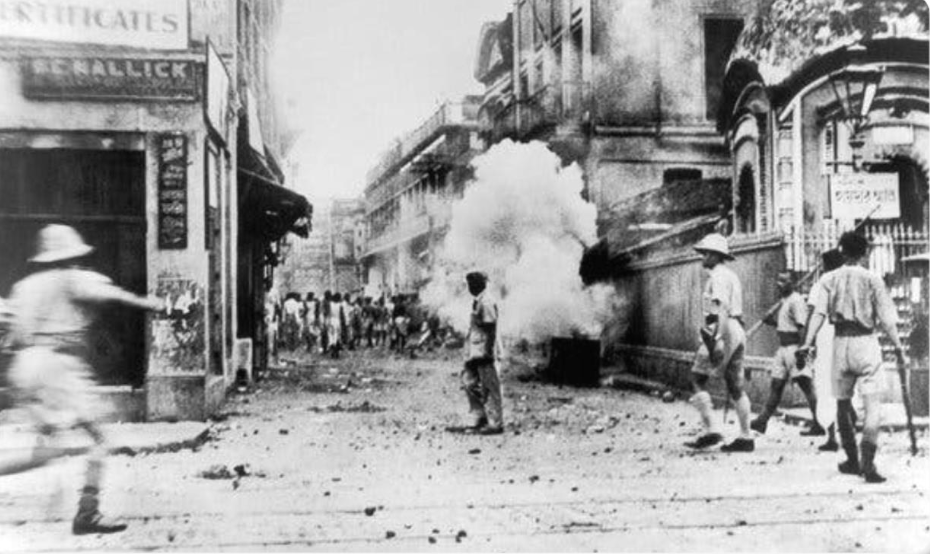
Pressure from Muslims to leave the village was on the increase. Acts of planned violence, arson, killings in the area were increasing manifold, creating intense fear for the non-Muslims. Communications of all sorts were totally cut off. The political scenario was also very confusing and hazy. No alternatives were available. Hindus were cornered from all sides and were left with no option but to consider leaving their villages. This was a very difficult decision indeed.
Unfortunately, the Hindus were not accepting the writings on the wall despite the fact that communal venom was being spread ferociously by the Muslims.
During this difficult period, the inevitable happened. Announcement of partition of the country was officially announced and this news spread like wildfire. Although, no authentic details were known, the message went around that our Tehsil Shakargarh of Gurdaspur District had gone to Pakistan while the other Tehsils of the district across the river Ravi had gone to India. Members of our family were still hoping for some unknown help and depended upon the support of their close friend, Mr. Rogue and his associates. As such they were delaying their decision to leave the village.
Chapter 8: BETRAYAL
Deterioration of law and order combined with overt directions of Rogue and his friends compelled the Hindus to succumb to their pressure to leave their homes for their own safety. Hindu families around our village were also forced to fall in line with this decision. After lots of deliberations, it was agreed that a group of about 500 to 600 Hindus would leave together on a fixed day to ward off any situation of ambush or attack. Safety and security of all were cited as the prime considerations. As such it was decided that the group should move together and be escorted adequately. All arrangements for exodus of such a large group to reach the riverbank safely, and then to be transported in boats across the river Ravi were confirmed to have been made by Rogue. I repeat that the Hindus had put their total faith in the genuine loyalty, friendship and action plan of Rogue. Nobody doubted in the least about any mal intentions or betrayal by Rogue.
Morning of 27th August 1947 was decided as the day when the group of about 500 to 600 Hindus would leave their homes and hearths, their ancestral land and depart for India. Dividing boundary between India and Pakistan was the river Ravi. To reach the riverbank the group had to travel a distance of 5 to 6 kilometres on foot.
Thereafter every Hindu had to cross Ravi to reach the other shore, to land in free India. Incidentally, Ravi was ferociously in spate during those days as it always used to be during rainy season.
For such a large group of about 500 to 600 persons – to travel the distance through unsafe route, and to ensure their safe transportation in boats required detailed arrangements. Mr. Rogue assured everybody that all necessary arrangements had been systematically planned and finalised. They were just to follow his directions to reach India safely. This was repeatedly asserted by Rogue. He made it clear that the Group would be escorted personally by him and his associates so that they could protect and take care of any untoward incident. It was assured in particular that arrangements of adequate number of boats at the riverbank (called Pattan) had been made to ferry everyone across the river.
To demonstrate their confidence in Rogue and to impart general impression that the group was moving peacefully and without fear, Hindus, young and old, were required not to carry any arm sword, spear, even lathi on the day of departure. So, all had to move totally unarmed.
Yes, the group (the “Kafila”) moved as planned on the morning of 27th August, 1947, peacefully, without any arms, hoping for a safe journey, though with a very heavy heart. They bid goodbye to their land. Most of the group members were on foot, a few on horse backs. They marched towards the river with fear of the unknown but trust in the friends and their loyalty sustained their confidence. The Kafila moved on its journey to reach Ravi. There was no major untoward incident en-route.
Oh God, what happened thereafter was unbelievable. Total treason, betrayal, breach of trust, faith and confidence by Rogue and his associates. They withdrew themselves from the responsibility to escort and reach the group safely, some distance before the riverbank, and left everyone to fend and defend himself. They bid goodbye and left.
Chapter 9: TRAPPED
The Hindu group had hardly reached the riverbank when they observed that they were being surrounded in a semicircle by Muslims, on foot, on horsebacks, fully armed with swords, daggers, axes, spears, lathis, hansia etc. They were shouting anti Hindu communal slogans, demonstrating their hatred against the very Hindu friends whom they had escorted a while ago. They were approaching in a strategic formation which encircled the Hindus and blocked them from all sides. Nobody could run away from the front, breaking their circle or from the rear as there was the Ravi river on that side. All Hindus were trapped. Intentions to kill were menacingly very clear. The “friendly Muslims” had schemed to kill the Hindus after they reached the riverbank.
Hindu elders huddled together to assess the emergent situation, but had no solution to stop the fanatic, sloganeering brutal attackers. Fighting back without any arms was a losing proposition. What happened to their life, and how to save the life and honour of ladies were urgent concerns, but they had no solution. Militants menacingly rushed towards Hindus. There was really no way to save any life. Utter confusion prevailed. Fear of death and getting killed was so real, with no way to escape. There was nobody to lead, guide or suggest the course of action.
Crucial decision had to be made within the fleeting moments. In response to this emergent disastrous situation, the young persons in the group took the initiative and asked the children, ladies and elderly to huddle together. They formed a circle around them to protect and got ready to face the attackers. It was no doubt a desperate measure for protection and survival. The confrontation was between un-equals, unarmed against armed, those stunned by total surprise versus those prepared with a plan to kill. There were no options. Anyway, the Hindus were the victims destined to die that day!
As the Muslim attackers inched closer to the entrapped Hindus, they were surprised to find that Hindu youth were standing ready to confront them. It was at an eyeball distance.
Both sides realised that it could be a war of nerves. During those horrible moments, Muslims flashed their arms, shouted inflammatory communal slogans and charged attack on Hindus with all vehemence. Some young Hindus fought back barehanded.
Some snatched arms from the killers and attacked them. They injured and even killed some Muslims. They were however overnumbered and overpowered soon.
During that mayhem, the feeling of insecurity among Hindus reached a flashpoint.
Chapter 10: NO CHOICE LEFT
Some men women and children, who were close to the riverbank, jumped into the flooded river to escape death at the hands of the Muslims. Such action weakened the Hindu defence and morale and encouraged Muslims to attack Hindus without any resistance. At that stage, Hindus were left absolutely with no choice but to get killed or jump into the river and take a chance if they could reach the other shore, India. More and more ladies, even with infants, girls, boys, men young and old, all rushed towards the river. Most of them jumped into the waters and were swept away by the river stream before Muslims could reach them. Those, who got trapped by the Muslims just could not escape death.
Only a few survived this ghastly massacre.
It is essential to note that in total breach of trust, Rogue and his associates had ensured that no boat to transport the Hindus across the river, as promised, was available at the Pattan (the area from where boats start and stop). Hindus were compelled as fate accompli to jump into the river and risk their lives in the river Ravi. It was said that boats had been moved miles away from the Pattan.
Being unwell, I could not run around and follow my elders. I was left behind on the riverbank. I did not apprehend as to what was happening around me and remained there helpless throughout the day until about sunset.
Personally, I was hit several times, severely wounded, and left as dead. The Almighty seems to have destined those deadly wounds and injuries for me, but not death. I am 83 years old today as an eyewitness to many violent acts on that day.
The ghastly scenes of human killing, blood gushing out of the human body leading to death still haunt me.
Chapter 11: HAUNTING MEMORIES
I would like to share a few incidents that I witnessed on that day (August 27th, 1947) on the riverbank.
The first nasty happening that I witnessed that morning was that Billu, a boy of about my age from our village, and I were standing near a tree holding the arms of his father, our village Pandit, looking in bewilderment. Little did we realise that a bloody Muslim had spotted us and was rushing towards us on his horse back. By the time we became aware of this, the killer had cursed and beheaded Billu’s father. Both of us instinctively ran away in different directions. I did not see the dead man again.
The first hit I got was on my back soon thereafter. It was by some long-edged weapon (like hansia) by an unrecognisable person from behind. It hit my backbone taking away a piece of flesh and causing a deep wound. I started bleeding profusely and fell down unconscious. Even when I was in that stage of unconsciousness, I was hit several times by spears by Muslim attackers, whoever passed by that spot.
Their intentions were clear to ensure that every Kafir was killed, leaving no chance of survival. Anyone who saw me with deep wounds, lying and bleeding in that condition simply exclaimed and added me in the list of dead.
I have no idea when I regained consciousness. It must be in the afternoon. At that time, I recognised Billu hiding in a bush near me. He had covered himself with some cotton sheet which he got on the riverbank. We could hardly exchange a few words when Billu cautioned me about the coming danger, two Muslims with swords flashing and coming towards us.
Billu quickly hid himself in the bush. I remained lying where I was. I found that a few others had gathered near me. The Muslim killers reached near us and asked each one to hand over cash, jewellery, and other valuable to them otherwise they would kill all of us. I did not have a penny with me. Others handed over to them whatever they were carrying with them. One elderly Sikh gentleman took out a wallet from his pocket and handed it to those attackers, pleading that he had only that much and no more.
Meanwhile, a young Sikh boy about my age got very panicky. He stood up and started crying. He implored with those Muslim attackers that he had nothing on his person. He took out his shirt to demonstrate that he had nothing to offer, begged and pleaded mercy for himself. Oh, no! One Muslim butcher hit him so hard on his neck with his sword that he fell and died. They collected the money and went away from there, abusing us as Kafirs.
Time passed and about a dozen Hindus gathered again near the spot where I was lying. Everyone in the group was mentally reconciled to the fact that except for a miracle there was no hope to survive. I do not know what their physical condition was at that time. After some interval, another wicked Muslim duo came near us.
One of them was carrying a sword and the other one an axe. They threatened us again to hand over all cash, jewellery and valuables to them otherwise they would kill everyone in the group. The elders in the group explained that they had handed over everything they had to their allies a while ago and they had been left with nothing. All their explanations, requests and beseeches had no effect on the Muslim duo. They hurled abuses in a very demeaning manner, cursed us as Kafirs and shouted that all Kafirs deserved to be killed. They had come prepared to kill.
In total disregard of the pleadings, they started the pre-planned killing. Irrespective of age, gender both started slaughtering each one of us, by rotation, first by sword and the next by axe. I have a clear picture in my mind how the lady lying by my side was hit by the axe on her neck. She started bleeding and sighing. Oh..oh..oh, my turn was next. I was hit on my neck with the sword. God knows how I acted so smartly, threw my neck on one side in a manner that it looked as if all was over and I was dead. After me, they moved on to the next and carried out their nefarious mission of killing others in our group.
When I realised that the Muslim killers had left the place, I asked the lady by my side repeatedly (I called her Tayiji) as to what had happened. She was from our village, a Brahmin, whom the whole village respected and took care of her daily needs, food etc. She would just not utter a word except sighing. Oh..oh..oh, I could not understand what had happened to her. Fate of others in the group is not known, probably all would have died.
God granted an escape route to me some time later towards sunset. Billu was in hiding all through the day and remained unhurt. Since the river Ravi was ferociously in spate during that time, I was told that probably the others in the group might have been swept away by flooding water during that night, leaving no chance of survival for anyone.
A body of an infant drifted towards the riverbank and was seen floating around in circles. No doubt it must have separated from its mother who would have jumped into the river and could not hold the child for long due to strong water waves. One Muslim guy saw the floating dead body of the infant and exclaimed to the other about the death of another Kafir. The other Muslim looked at the dead body and asked his companion how he was so sure that the child of a Kafir (son of a snake, “supolia”) was really dead. He aimed his spear at the body of the floating dead infant and pierced the same into him. He was shouting that no Kafir should remain alive.
Such was the extremism of feelings and intensity of hatred against Hindus.
Later on, I learnt that the infant was nobody other than my own cousin brother, son of my Tayaji. Incidentally, this Tayaji was my angel guardian who took complete care of me in the village, and also after I landed on the Indian side on the evening of August 27th, 1947, totally given up as dead.
Billu was the only person with whom I exchanged some conversation that evening.
Surely, he remained most of the time away from me for safety reasons. There were a number of household items scattered on the ground near us. I spotted one geometry box lying there, and asked Billu if he could get me the same. Billu brought the box to me. It was an ordinary used geometry box which contained one scale, one pencil, an eraser, a pencil sharpener and one compass. I carried this box with me to India and kept it with me even under very difficult and painful times, as a precious, sentimental souvenir, until it was lost during one of our family movements from one city to another.
CHAPTER 12: OM, MY SAVIOR
Towards the evening there were no movements seen. It was the eerie, chilling atmosphere all around. It seemed as if all was over. The sun was about to set and after a while it would all be dark, and frightening night would start. I was lying down on the ground, eyes closed with excruciating pain, mind blank, totally unaware of what was in store for me the next moment. There was no hope nor any possibility to escape from there. Everything depended upon destiny and destiny alone. I prayed silently within myself, Om, Om, Om, tried to settle down and calm myself. I prayed to God to do whatever was best for me.
Suddenly, after a while, I saw some men rushing in one direction. They were not seen on the riverbank, so must have been hiding somewhere nearby. I watched a few of them and then enquired in my feeble voice where they were rushing to.
Nobody paid any heed to what I was asking. I repeatedly made the same enquiry but it was ignored every time. I got no response. I could sense some urgency in all of them to run in the same direction. I learnt later that they wanted to reach a boat from where loud calls had been made for Hindus to reach fast, to escape from that place. Billu had already run in that direction. God knows from where I got the energy and I got up and started walking in the direction in which others had gone.
I walked about 500 steps along the riverbank with great difficulty. There I saw a boat parked in the stream, rather away from the riverbank. I noticed some hands waving to me to reach the boat hurriedly. I waded into the river water but could not keep my balance after reaching a certain water level. Every time I tried to move forward, I would lose balance and fall. It became extremely difficult for me to move even a step forward. The situation was further aggravated when others who went past me totally ignored my inability to move forward, rather rushed fast towards the boat. The slim chance to escape from that mayhem seemed to be lost.
I continued struggling all the time to reach the boat though unsuccessfully. I would fall, get up, and fall again. Suddenly two strong arms got hold of me and stopped me from falling. The gentleman lifted me physically, carried me up to the boat in very assuring manner. He made me sit in the boat in a caring and affectionate manner.
As soon as I was seated inside the boat it started sailing back towards the Indian shore. There were about a dozen of us, a few seriously injured. I learnt subsequently that one person from our Kafila had been amongst the early ones who
jumped into the river. He reached the other shore, approached and explained to the villagers about the violence perpetrated, and the indiscriminate killings of the Hindus by their own confidante Muslim friends. He requested them if some arrangement could be made to rescue any Hindu who might be alive by then.
Nobody was initially ready to risk their life. The incidents of horrible, cruel killings on the other side ultimately made the villagers agree to send one boat with a gunman. It is said that the volunteers in the boat, when they reached near the shore on the Pakistan side, shouted that any Hindu needing help to move away from the river side should reach the boat fast. As a result of such calls some Hindus rushed towards the boat. I was the last person to get into it. Some Muslims might have been resting nearby. As soon as they heard the call from the boat for Hindus for safe escape, they rushed towards the boat with coarse expletives and inflammatory abuses, determined not to let any Hindu Kafir escape alive. That was the reason our boat did not wait much longer and hurriedly sailed back towards Indian shore.
I do not know how much time was taken by our boat to reach the Indian side. But as soon as the boat reached near the Pattan, the passengers sitting inside jumped out without waiting even for a moment. They moved away, perhaps due to fear and trauma. But I could not get up. Eventually, I was taken out of the boat by the gentleman who had brought me inside the boat on other side of the river. I learnt later that he was our next-door neighbour in the village although I did not recognise him when I was seated on the riverbank.
CHAPTER 13: MY GUARDIAN ANGEL, TAYAJI
The sun had set in the West and it was becoming quite dark in the night. I lied there on the riverbank unattended, waiting for someone I knew to come. The Hindus who had reached the Indian shore waited anxiously for their family members, relatives and friends to come. They gathered near the Pattan as it could be the most convenient location to meet. Individuals trickled in one by one, weeping and crying.
Their blank eyes looked around in all directions for their own, but hardly anybody was seen. All were aware that their family members had jumped into the river about the same time. Therefore, casualties at the hands of the Muslims were not expected although fear of their getting swept away in the river increased.
As the time passed, the realisation that the family members had not been able to cross the river and might have been swept away by the waves became stronger.
But the hopes were still very high about the safe arrival of those who were young and good swimmers. Somebody said he had seen some of our family members swimming together with the support of wooden logs. Some others were seen having reached very close to the riverbank on our side. None of them reached. Time weighed very heavy since it was getting very dark and cloudy. Strange enough, one of my uncles who was somewhat mentally ill, reached the Indian shore. When asked, he said there was no water on his way and he comfortably walked on the sandy riverbed and crossed the river.
There were more disappointments with the passage of time. All were fully conscious that the river Ravi was in full spate and it would not but sweep away everything inside the water or on the banks during the night. Therefore, the time for moving away from the riverbank and survival was very limited. This thought by itself was very worrying and horrifying. It was a strange irony that only a handful of young children, in teens or less, and a few elderly persons reached near the place where we were that night. No lady nor any young man including good swimmers reached.
During that dark evening, full of utter desperation, while I was lying listlessly on the riverbank my angel Tayaji spotted me. It was not possible to gauge his grief as his wife and two sons had not reached by that time, and they have not been seen till today. Even Tayaji is not alive now. He was shocked to see me bleeding so profusely. Immediately he took me under his care. As the lingering hope of some others to reach the Indian My Tayaji (Uncle)
side waned and the weather started getting wet, the dozen people gathered there decided to move away from the Pattan.
Someone confirmed that he had been able to find a small Gurudwara nearby where they could take shelter.
All surviving persons in the group moved to that Gurudwara and sought shelter there. The name of the place probably was Kalanor, but I am not sure.
A small cot was arranged for me, and I was made to lay down on that. I was bleeding continuously throughout the night. My Tayaji told me later that he found two earthen pots which he used to collect the blood so that it would not soil the floor. He used to keep one pot near my body to collect the oozing blood and would empty it in the open where it would flow away with the raining water. Meanwhile the other pot would be kept under my body to collect the blood. This process continued practically the whole night. No medicine or medical help was available there.
In the morning, an indigenous “Desi” method to stop the flowing blood was thought of. A piece of cloth was burnt, and its ash was to be applied on the wounds. But they found that the clothes I was wearing were fully drenched in blood and had got stuck to the body. It was very difficult and painful to remove the clothes. So, my clothes were cut, torn, and removed and then the ash was applied. At that time, I was dressed exactly in the manner when I was born ten years ago. A cotton bedsheet covered my body later.
The area around the Gurudwara was heavily flooded for miles across. Movement from one place to another was very difficult, if not impossible. We had no option but to continue staying at that place till the flood situation improved somewhat. During that period of grief, time passed wishing, hoping and expecting some others to come alive.
With every passing day some news would reach that a particular person had been seen and that he had also been trying to contact others. Some villagers or the odd person who moved around were the only medium of information. A few others joined us at the Gurudwara, place of our shelter. After 4 to 5 days, as the rains stopped and the floods receded to a safe level, and also having realised the futility of waiting longer for others arrival, Tayaji along with others decided to move out of the Gurudwara and reach Dorangla village where we already had some relatives and my Nanka (house of my maternal uncle).
CHAPTER 14: REUNITED
It was a tough journey from the Gurudwara to Dorangla, about 4 to 6 kilometers, wading through the muddy waters. Four persons carried me on their shoulders, with me lying on the cot. Others who came to know about our movement joined us en-route to Dorangla. The news about killings, barbaric inhuman treatment given to us by the Muslims had spread around, and our people in Dorangla were very furious after knowing such a great human loss of their relatives. As our small group reached near the village boundary, I remember many people watched us pass by from their roof tops. Later on, the residents of Dorangla village used to identify me as Agya wanti’s (name of my mother) son, who had come on the cot.
The degree of anger, hate, and the urge to wreck vengeance against Muslims was very high in the hearts of all Hindus. I learnt later that as a measure of retaliation and vengeance, the Hindus of the village gathered all Muslims, young and old, man and woman in the village and gave them the same treatment that Hindus had received at the hands of their Muslim friends, and killed them.
Although this action was to give vent to their anger and grief, it just could not compensate for the losses we suffered due to treason and betrayal by Muslims on other side of the river Ravi. We counted eleven members of our family as dead, those who could not cross the river Ravi to witness the freedom of India.
In Dorangla, I joined my mother and siblings, who had already come there earlier at our maternal uncle’s house. While recovering from the trauma and injuries, the haunting memories of that period have faded, perhaps due to my medical condition.
I used to miss my father too much and cried for him quite often. The circumstances in those days did not allow my father to visit us at Dorangla. After some time, however he managed to visit us barely for 2-3 days, and then left for his office. But his departure was not mentioned to me that day.
One indelible picture, I have in my memory is how I used to be carried by four persons on a cot, to a doctor for dressing of wounds and other treatment. This doctor was not residing earlier in the village. It’s not known to me where the doctor came from, maybe the elders would have known. Visits to the doctor and dressing of the wounds used to be a very painful process, but I had to endure that.
CHAPTER 15: BLESSINGS OF THE ALMIGHTY
My Tayaji and other members of the family did not want to remain dependent on their relatives in Dorangla beyond a reasonable time. So, after some days as the weather improved and having made some arrangements for basic daily needs, they moved to Dhariwal in district Gurdaspur. Why Dhariwal was chosen as the place to settle, I am not privy to that, may be proximity to relatives in that region. I stayed back with my mother, because the doctor attending on me advised against body jerks, and also against long rough drive in Tonga on dilapidated roads. My mother with four of us (her children) joined the joint family at Dhariwal after my medical condition became stable.
This is a brief description of events based on old memories in my life, the way I experienced them just around partition of our country and particularly on August 27th, 1947; and also the heavy price our folk from remote villages paid in the fight to achieve independence of India. What an irony, we were labelled as refugees having gone through all the tortures, losses and sacrifices when we reached our own country. We lost cash, jewellery, land, wealth, valuables even human heads.
Wouldn’t you shudder at the very thought of having witnessed beheading of human heads, and would your blood not boil when big political leaders of the country extol that “Bina Khadag Bina Dhal”, meaning without any sword and shield, and without shedding a drop of blood they got freedom for the countrymen? Don’t be naïve. Be honest!
As I said, my objective is to record happenings as I personally experienced them around the time of the partition of our country in 1947 in this memoire. It records the migration of about 500 to 600 Hindus out of whom barely 50 could reach the shores of free India as per the best possible information from all affected persons/families. I am one of those 50 lucky ones in this lot.
There were undoubtedly many such events during that period, even more ghastly and barbaric in other parts of the country, which others can share. I stop now, having narrated the happenings of more than 70 years before, as honestly as I could remember them.
EPILOGUE
For me personally, it has been a long journey of life from age 10 to over 83 years now. My family went through tremendous amounts of ups and downs in all aspects of life. Like nomads, we had to move as victims of circumstances from one city to another, Dorangla to Dhariwal to Dehradun to Narela to Sonepat and finally now at Faridabad. Most of this time, my father had to be away from us as his postings used to be in very far flung places.
It has been a tough uphill climb for me from a stage where I had been given up as dead on the bank of river Ravi to moving about with physical disability, and then moving on the path of physical, educational and professional recovery and growth. It has all been possible only due to extreme kindness of the Almighty.
I am living a full life with three very affectionate, loving, caring children, Sangeeta, Sanjeev and Rajeev, well settled in life and the grandchildren faring well for themselves. My life partner of over 53 years, Sudershan, departed for her heavenly abode six months ago on Feb 10th, 2020.
After living life in such a varied manner, I cannot but express my gratitude in all humility to the blessings of my parents, elders, friends, and above all to the Almighty.
May all be happy. May all be free from illness.
May all see what is good. May no one suffer.
Om…Om…Om.
BONUS
Dad had kept the interview confirmation and readily found it for me when I asked it in mid- August, 2020. I sent a note to the email address listed on the note, with little hope of even any acknowledgement, but lo and behold, Karyn responded within a day, and the day after sent me a link to download the actual video.
I’ve uploaded my personal copy video on YouTube2. The video is to be shared within the family and is not to be forwarded or broadcast, as per the media rights owned by the 1947 Partition Archive organization.
– Rajeev From: 1947 Partition Archive STORIES <stories@1947partitionarchive.org> Sent: Tuesday, August 18, 2020 4:13:59 PM To: Rajeev Mahajan Subject: Re: Obtaining the audio transcript Dear Rajeev, Thank you for taking the time to request a copy of Rajendra Kumar Mahajan’s shared memories of Partition, which educate the current and future generations. Our video editing team has just completed the processing and formatting of this interview and we are excited to share the final version with you. For your convenience, please use the provided link below to download the video.
Follow the instructions on how to preserve a copy of this interview.
We are honored to have this opportunity to preserve this unique story into perpetuity.
If you have further questions regarding the interview video, or The 1947 Partition Archive’s work, please feel free to contact myself or anyone at our team at your convenience. If you wish to extend support to this cause, which is supported entirely by community members like yourself, a contribution can be made at our website: https://www.1947PartitionArchive.org/donate Sincerely yours, Karyn 2 Link: https://youtu.be/9x3xTN-cGKg
GLOSSARY
Basant Panchmi: Hindu festival that marks the beginning of the Spring season, and is dedicated to Saraswati, the goddess of knowledge and music. The festival celebrates the agricultural fields’ ripening with yellow flowers of mustard crop.
Basanti: The color saffron or yellow.
Sooji Ka Halwa: Indian pudding made using fine semolina, sugar and ghee (clarified butter) OM (ॐ) is the sacred sound and symbol in the Hindu religion. It signifies the essence of the ultimate reality and consciousness or Atman (Spirit/ Soul).
Arya Samaj: Hindu reform movement that promotes values and practices based on the belief in the infallible authority of ancient Hindu scriptures, Vedas.