
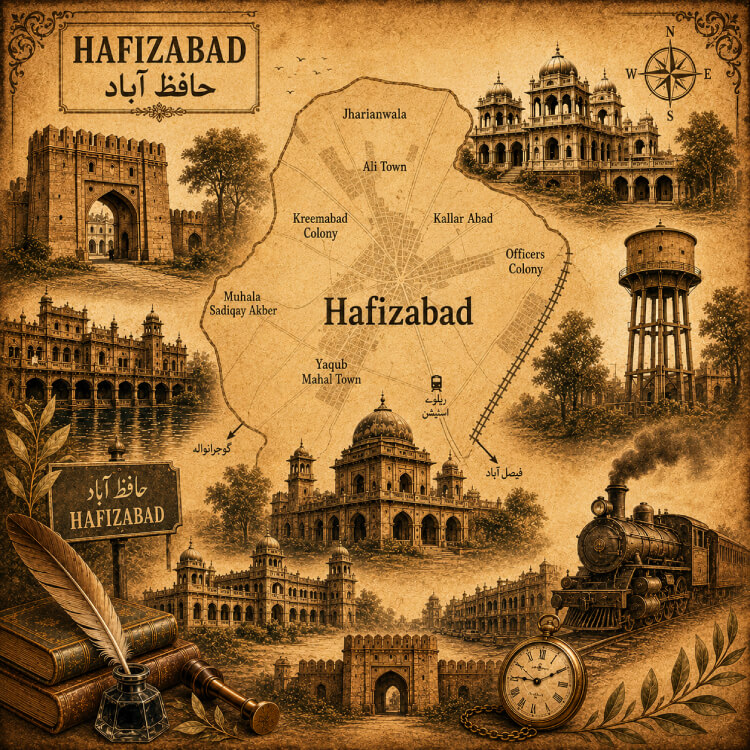
Hafizabad is a city and capital of the Hafizabad district located in Punjab, Pakistan. The city of Hafizabad is situated 30 miles west of Gujranwala and is 37 miles away from Wazirabad. The river Chenab forms its Northern and North-Western boundary, on the North-West it touches Mandi Bahauddin, in South, it has Sheikhupura, on the West it has Sargodha and Jhang, and Gujranwala is on the East. The geographical coordinates of Hafizabad are 32.4′ north 73.41’and has an Altitude of 207m. At the time of the partition in August 1947, it was the eighth railway station from Lyallpur (renamed to Faisalabad).
Hafizabad, at different times, has been ruled by many kings who had their capital in this area of Punjab. In the early seventh century, the Chinese traveler and Buddhist monk Hyun Tsang (alt. Chinese name Xuan Zhang) also came to this area and stayed at Jaipura (now known as Kot Hasan Khan), a village in Hafizabad Tehsil. In Ain-e-Akbari (Akbar’s biography) Hafizabad is mentioned as a Pargana in the Rachna Doab under the Lahore division. When Alexander the Great invaded India in 327 BC, the area of Sandal Bar on which Hafizabad is situated was well
populated.
During the regime of Ashoka, the Great, Hafizabad was a big centre of Buddhism, and the big city of Asrora existed here, from here big statues & stupas have been found. The area was known to have been thickly populated along the River Chenab, both in the Hindu & Bodh periods.
There are several versions as to how the town was named Hafizabad, but a common belief is that Hafiz, a minister in King Akbar’s court and one of his favourites, got inhabit a township which took after his name as Hafiz Manarak, later getting renamed as Hafizabad.
During the Muslim period, the area of Punjab became a passage for Muslim Armies and Caravans going from Sindh to Sialkot, Kashmir, and Kabul who used to go through Hafizabad.
In the period of King Aurangzeb, the royal title holder Lachi Ram Kapur came to this place, he established relations with the Chopra caste and settled at Hafizabad. Over time as the influence of Samara & Arabs was eliminated in the Punjab region, and the power came into the hands of Hindus, the town developed as a Hindu town. The early Hindu inhabitants of Hafizabad were considered to be Chopras and Kapurs, who were rich and famous and owned about 2/3 rd of the property in the town.
The Mughal Empire was already on its downfall during the regime of Aurangzeb, and after his death in AD 1707, wars of succession followed which made the
empire both internally and externally weak. The Punjab region during most parts of the 18 th
century, between 1716 to 1799, was highly turbulent, as the rise of
Sikhs and foreign invasion from Nader Shah of Iran created a lot of instability. The first large foreign attack on Hafizabad was of Nader Shah of Iran followed by
endless attacks by other raiders. The foreign raiders used to loot the city and go back, after which the local raiders and thugs would come and take their bounty.
It was also a saying among people of Hafizabad at that time ‘Khadda Peeta Lahe Da, Baki Bacha Nader Shahe Da’ (What so ever you eat that is yours, anything
you save, that Nader Shah will take).
The ancient town of Hafiz Manark, which had been established by Hafiz during King Akbar’s reign got vanished due to numerous raids and attacks by foreign invaders. With the return of normal conditions, the people of the city started coming back and founded a new township with the same name, which is the
present city Hafizabad. The people got together and made one market and to its north and south three streets leading to residential places named as Kucha Chopran, Kucha Sethian, Kucha Kasaban, Kucha Tandanan, Kucha Mahantan, Kucha Wadhawan, and constructed watch-towers and high walls around the town. The area was divided under the leadership of different Sardars (leaders) who constructed Qilas or forts for their protection ie. Qila Didarsingh, Qila Mihan Singh, Qila Sahib Singh, etc. which were under the overall protection of Hakim Dayal Singh Merakotia. Hakim Dayal Singh had his residential house in Kucha Tanduwan and his Dewan-Khana (public court) was at a place called Chah Qaziwala. Under the protection of the foresaid headmen, the people from all religions got settled in Hafizabad and when others got confidence they also started coming back. Sardar Gurbaksh Singh Kapur in his book ‘Kapuran-e-Hafizabad’ describes that our ancestors ran to Kurali during the period of lawlessness and returned after the restoration of law & order and they named their street Gali Kapuran and the families of six brothers started living there, they made six houses and six shops and made the eastern gate of the city and thus the Kapur Kunba was established at Hafizabad.
The research has revealed that the new city of Hafizabad starts from Kucha Sardar Jawahar Singh Kapur and the city came into existence in the year 1760.
Sardar Gurbaksh Singh further writes that for making houses these people brought wood etc. from ruins of Sayyed Nagar near Alipur Chatha. The power of
Sikhs affected common people to a great extent and the majority of Hindus adopted Sikhism.
The city was within a circular road. The Hindu population was in the middle and Muslimslived along the outer side of the road. The city had Tehsil, a Public Park
in the East, and on the West well of Bawa Lal and Devi Dwara, and a hospital and towards south-west Idgah Akbari. On the South a graveyard, on the North
along the road a well (Chah Kazi wala) with its lush green vegetables and flowers. The water of this well was used unto Mandi Tirath Ram Kapur. In addition to this well, there were four more wells which were used by the public for the bathing, etc. The old road to Gujranwala was through Qilla Didar Singh, the travel used to be on foot, horses, and bullock driven carts. The Tonga (horse-driven cart) stand was near the Eastern gate of the city and near Shivala Kapuran (Shiv temple) and later with the coming of the rail the horse carts were reduced. The horse carts used to take 10-12 hours to reach Gujranwala and were plying in groups due to the fear of dacoits. The people hardly used to keep watches even in the offices there was no watch, the time was calculated with the help of the movement of stars, water dropping, and later with the help of sand dropping. The first Clock in Hafizabad was along the wall of the Tehsil office and the clock was a strange thing for the people over there particularly the movement of the Pendulum. The people were accustomed to calculate time through different unique methods- one interesting story is that the Tongas used to start at 5 am for long distances in groups and they used to get up one hour before far preparation, etc. One Tongawala—when asked by his colleagues to get up since the Tehsil clock has struck four would reply’ ‘Munu hale Muter Nahi Aya, Char kive waj Sakte Nai, Tehsil Da Ghanta Galat Hai’ (I am still not having the urge for urination then how it can strike four, the clock of Tehsil is wrong) and concerned Tongawala was proved to be correct.
Hafizabad was very famous for its functions, lifestyle, grandeur, Gurudwara Chavi Patshahi, Samadh Bawa Bhan Shah, various festivals, and
especially Ram Lilla.
Hafizabad was known to be very jovial, lively, and a full of life community where Hindus& Muslims used to celebrate religious and social functions together with great enthusiasm. The religious harmony and respect for mutual beliefs and sentiments were to such extent that in Hafizabad neither Beef nor Pork was sold or consumed. In my recent visit to Pakistan, I was told that even today, the older residents of Hafizabad do not consume Beef – for which BBC Television had interviewed people to know about the reason.

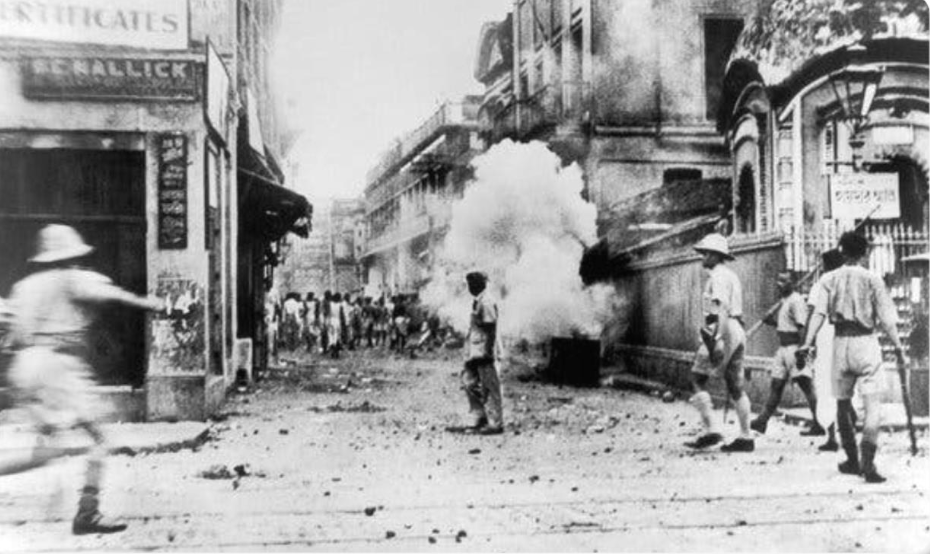
It was wintry day of December 1935 at Hafizabad (West Pakistan) the cold wave was in the full swing, most of the human beings as well as animals had tugged their heads within their legs and were braving the weather with the help of charcoal or wood burning.
With the dawn of sunlight on August 27th, 1947, a group of about 500 to 600 people of Hindu and Sikh faith started a one-way journey from their homes in remote villages where they had lived for generations to march into Independent India. I was a 10-year-old Hindu among those people.
Father’s parental village was Jandraka, which was a big village on the Banks of Ravi river.It was 130 km southwest of Lahore,in Present day Pakistan. nearest town was Okara which was also the tehsil headquater. These days Okara is a full fledged district. Jandraka was about 30-35 km away from Okara.
Help us preserve our shared heritage.